
AI is now part of almost every marketing conversation. Teams are expected to move faster, show results sooner, and do more with the same resources, and many are turning to AI powered tools to make this happen. According to McKinsey, 65% of organizations now report regularly using generative AI in at least one business function.
But this speed creates a new problem. As execution accelerates, it becomes easier to lose control of strategy, messaging, and priorities. That risk is higher in regulated healthcare markets, where mistakes carry real consequences. For SaaS, data, and professional services companies serving life sciences and healthcare, the pressure is even higher.
This is where most teams get it wrong. They focus on tools instead of ownership.
AI should support your marketing strategy, not drive it.
Most teams don’t notice the shift. They keep adding tools without thinking about the long-term impact.
Where does AI add value in B2B marketing, and where should teams stay in control?
AI works best in parts of marketing that are repetitive, data-heavy, and time-sensitive. For companies selling into healthcare and life sciences, that usually means execution, rather than determining direction.
AI can help accelerate early-stage research. It can summarize trends, surface common pain points, and help teams get up to speed faster. This is useful for companies selling into healthcare, where understanding the buyer context takes time.
However, the output still needs review. Context matters, especially in regulated environments.
Demand generation in B2B healthcare and life sciences does not move quickly. Campaigns take time to show results, and there are many touchpoints along the way.
AI helps teams test and adjust faster. It can support:
Faster iteration means teams can improve performance without waiting months for clear signals.
Reporting is where many teams lose time. Pulling data, formatting updates, and trying to connect activity to pipeline can slow everything down.
AI can streamline this by:
For healthcare SaaS vendors, sales cycles are long, and visibility into what is working is not always clear. AI helps teams see patterns earlier and adjust before problems grow.
Better reporting only matters if it connects back to real outcomes. That means tracking the right metrics, not just more data. If you are measuring performance in these markets, it helps to ground reporting in metrics tied to pipeline and revenue.
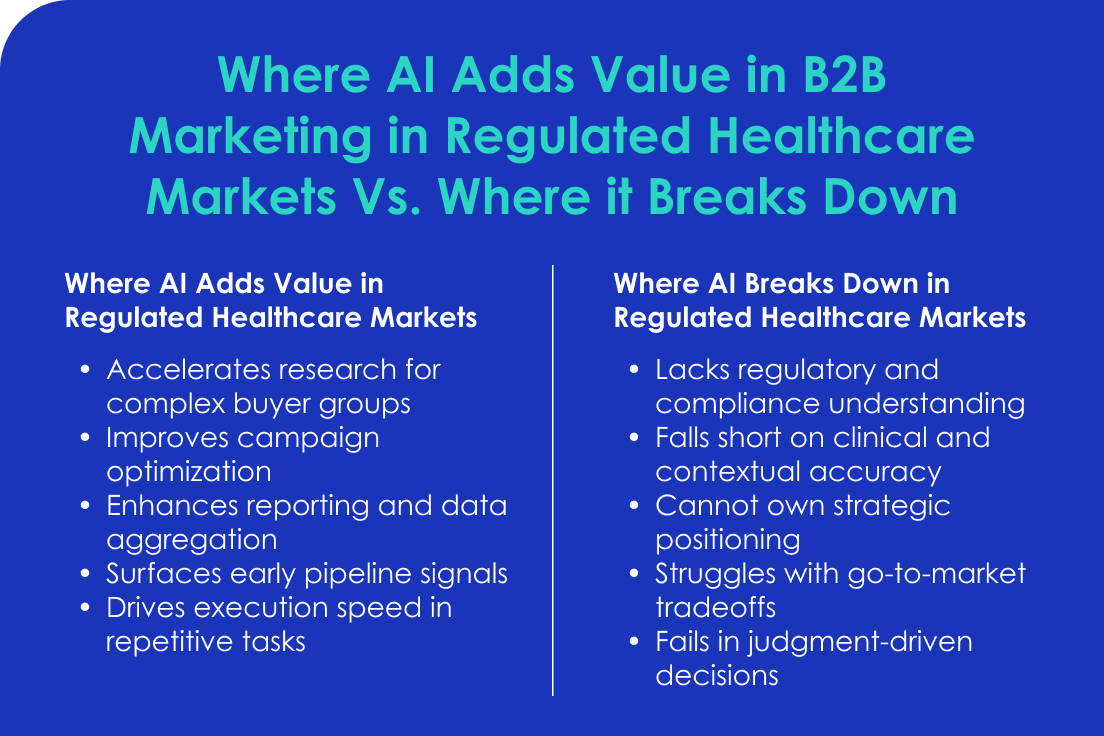
AI is useful in execution, but in regulated healthcare markets, the highest-risk areas of marketing are strategy, messaging, and judgment. This is where AI starts to fall short.
Messaging in healthcare is not just about clarity. It has to reflect regulatory constraints, clinical nuance, and the expectations of different stakeholders.
AI can generate copy quickly, but it does not understand:
For companies focused on B2B messaging for regulated healthcare markets, a message that is slightly off is not just ineffective; it creates risk.
In crowded health tech and life sciences markets, positioning is what separates one vendor from another. AI can summarize what competitors are saying or suggest variations, but it does not make strategic choices.
For SaaS, data, and professional services companies serving life sciences and healthcare, positioning is tied directly to go-to-market strategy. It requires tradeoffs that AI is not equipped to make.
Marketing in regulated markets is rarely linear. Teams are balancing:
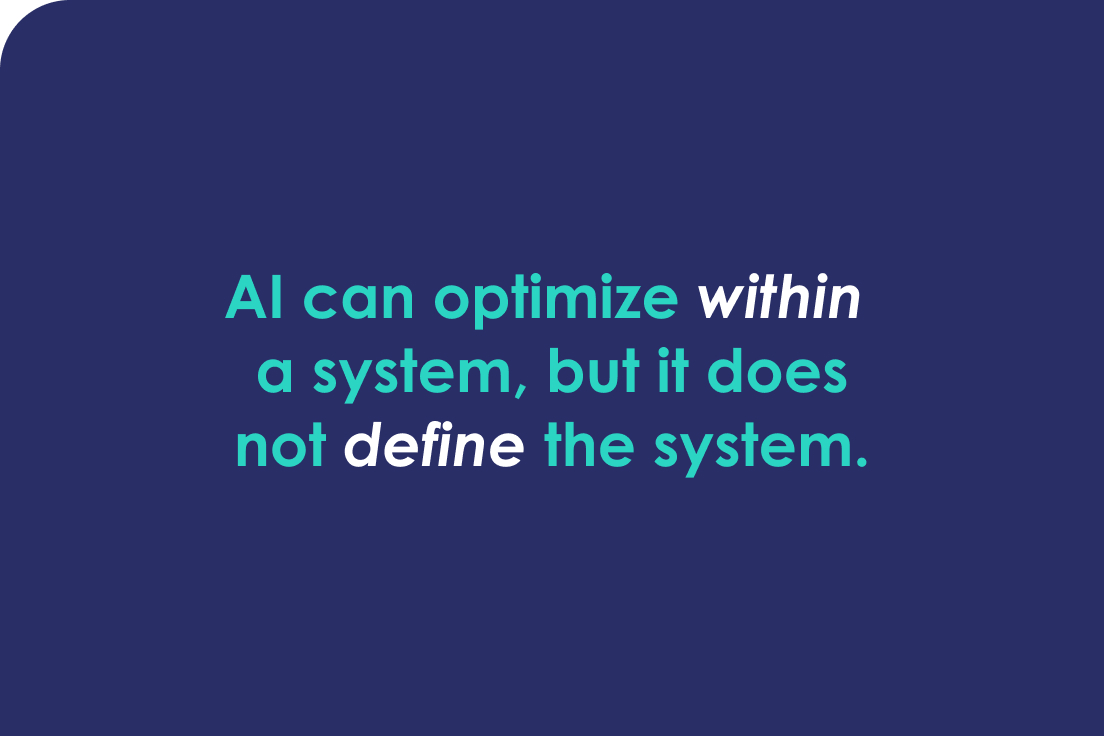
Across all these areas, the closer you get to strategy and judgment, the less useful AI becomes on its own. For teams working on go-to-market strategy for healthcare SaaS vendors, these tradeoffs are constant. They require experience, rather than automation.
For SaaS, data, and professional services companies serving life sciences and healthcare, the difference shows up in execution. The teams that perform best are not using the most tools; they are using AI within a clear structure.
This is done by defining the strategy upfront and ensuring that the messaging is tightly controlled. From there, AI is applied where it speeds up execution, not where it replaces judgment.
This leads to better outcomes:
While AI can surface data, generate outputs, and speed up execution, it does not tell you what to prioritize, what to ignore, or how to adjust when results are unclear.
That gap is where many teams struggle, and where experienced marketing leadership matters.
For many companies, that comes from working with an outsourced partner that understands both the market and the tools. A fractional CMO for startups or a fractional marketing team for startups can use AI to move faster, while staying grounded in strategy, messaging, and compliance.
They understand how B2B marketing for companies selling into life sciences and healthcare actually works. They know where AI can improve workflows and where it introduces risk.
That combination keeps teams focused. It turns faster execution into better decisions, not just more activity.
AI is already changing how marketing gets done. But faster execution does not fix unclear strategy, inconsistent messaging, or weak pipeline performance.
What matters is how AI is applied. It needs structure, ownership, and a clear connection to business outcomes.
That is where the right partner makes a difference.
Rebound works with SaaS, data, and professional services companies serving life sciences and healthcare to bring that structure into place. We help teams use AI to move faster, while staying grounded in strategy, messaging, and results.
Let’s start the conversation today.
Q1: How should AI be used in a marketing strategy for healthcare SaaS companies?
AI should be used to speed up execution, not define strategy. It works best in research, campaign optimization, and reporting. Strategy, messaging, and positioning should remain human-led, especially for companies selling into regulated healthcare markets.
Q2: Where should teams selling into healthcare and life sciences stay in control when using AI in marketing?
Teams should stay in control of strategy, messaging, and go-to-market decisions. For SaaS, data, and professional services companies serving life sciences and healthcare, this includes positioning, compliance-aware messaging, and how marketing connects to pipeline. AI can support execution, but it cannot replace the judgment needed in regulated healthcare markets.
Q3: Does AI improve B2B demand generation for companies selling into healthcare?
AI can improve demand generation by speeding up testing, targeting, and performance analysis. It helps teams iterate faster and identify what is working sooner. But results still depend on strong strategy and clear messaging.
Q4: What are the risks of using AI in regulated healthcare marketing?
The main risks are inaccurate messaging, compliance issues, and loss of strategic control. AI can generate content quickly, but it does not understand regulatory nuance or clinical context. Without oversight, this can lead to mistakes that impact credibility and performance.
Q5: How do you avoid relying too much on AI tools in marketing?
Focus on structure and ownership. Use AI within defined workflows tied to strategy and pipeline goals. Avoid adding tools without a clear purpose. Many companies solve this by working with experienced partners who understand both AI and B2B marketing in regulated healthcare markets.
To make sure you get accurate and helpful information, this guide has been edited and fact-checked by the Rebound Editorial Team.