
Growth-stage founders face the same question: should we build a marketing team or find another way to grow demand?
Building a team takes time. Recruiting, interviewing, onboarding, and alignment can stretch far beyond the quarter. General hiring timelines for marketing roles are long, with the average job posting listed for 39 days before a hiring decision is made.
For SaaS, data, and professional services companies serving life sciences and healthcare, delays matter. You are selling into complex organizations. Buyers expect clear positioning, strong proof, and consistent follow-up. Sales cycles stretch across months. If marketing moves slowly, revenue slows with it.
Many teams try to solve this by hiring one role at a time. A marketing leader first, then demand gen, then maybe a content writer, designer, and so on. But each hire needs onboarding, and each person has to build their own process. And so, alignment takes time.
Partnering with a fractional team inside a marketing acceleration model changes that dynamic. A marketing acceleration model activates a full marketing engine quickly, allowing strategy and execution to start together.
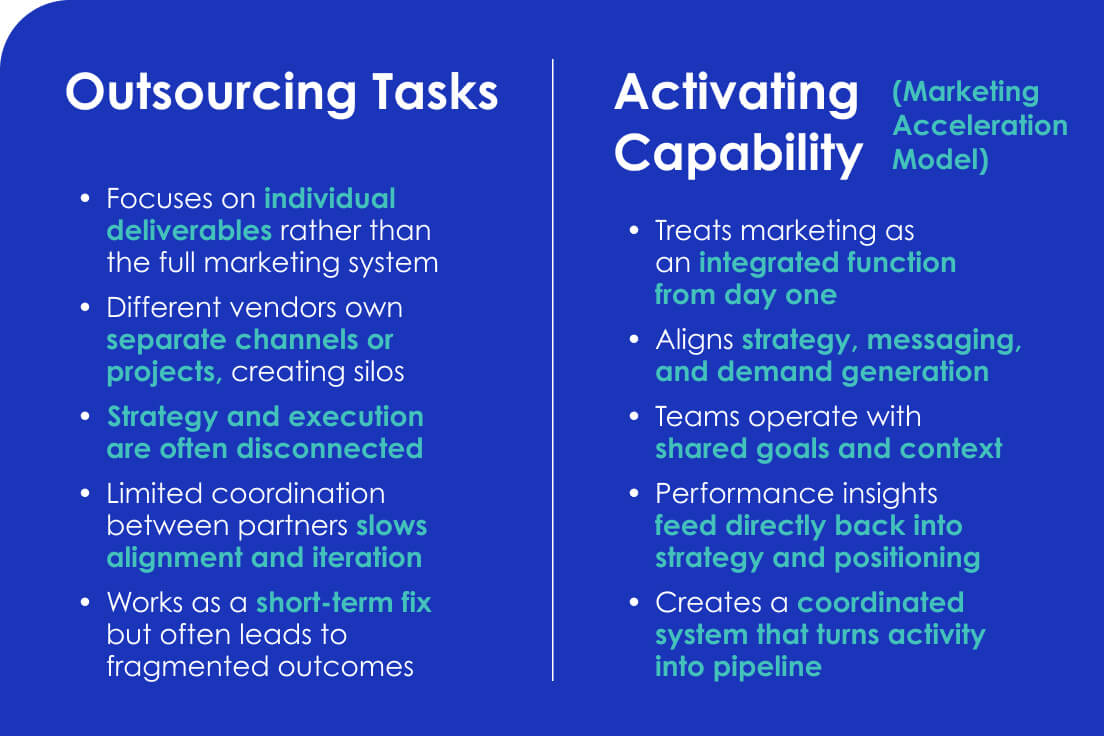
Outsourcing is a common solution to rapid growth or fillings in team gaps. Companies will hire an agency for paid media or a contractor for content, and each partner owns a deliverable.
This can help in the short term, but task-based outsourcing often creates silos. No one owns the full system, and these outsourced teams may not have communication with each other.
Over time, this creates friction and issues:
For companies serving life sciences and healthcare, that fragmentation is expensive. Regulated buyers expect precision, and value propositions need to hold up under scrutiny.
A marketing acceleration model treats marketing as an integrated function from day one. It aligns go-to-market strategy, messaging, and demand generation in one motion. That alignment is what shortens ramp time and it is what turns activity into pipeline.
In regulated healthcare markets, feedback loops already move slowly. Sales cycles are long, with industry sales cycles averaging 6 months or more to close a deal.
If marketing also moves slowly, the business compounds delay on top of delay.
Speed in this context does not mean reckless campaigns or sloppy messaging. It means shortening the time between decision and action.
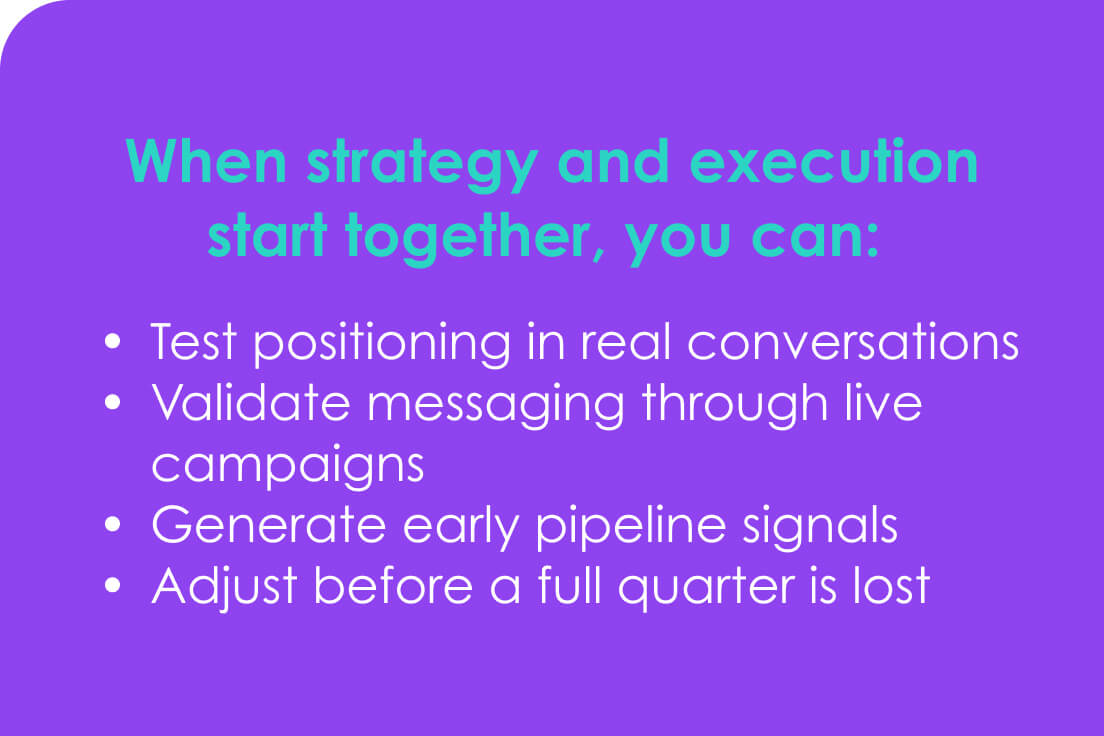
For SaaS, data, and professional services companies serving life sciences and healthcare, early clarity creates leverage. When messaging resonates, sales cycles tighten, but when it misses, you want to know quickly.
A marketing acceleration model prioritizes time-to-impact. It allows companies to launch coordinated B2B demand generation for companies selling into life sciences and healthcare without waiting for a fully built internal department.
The longer you wait to activate structured marketing, the longer revenue remains dependent on founder-led sales and ad hoc efforts.
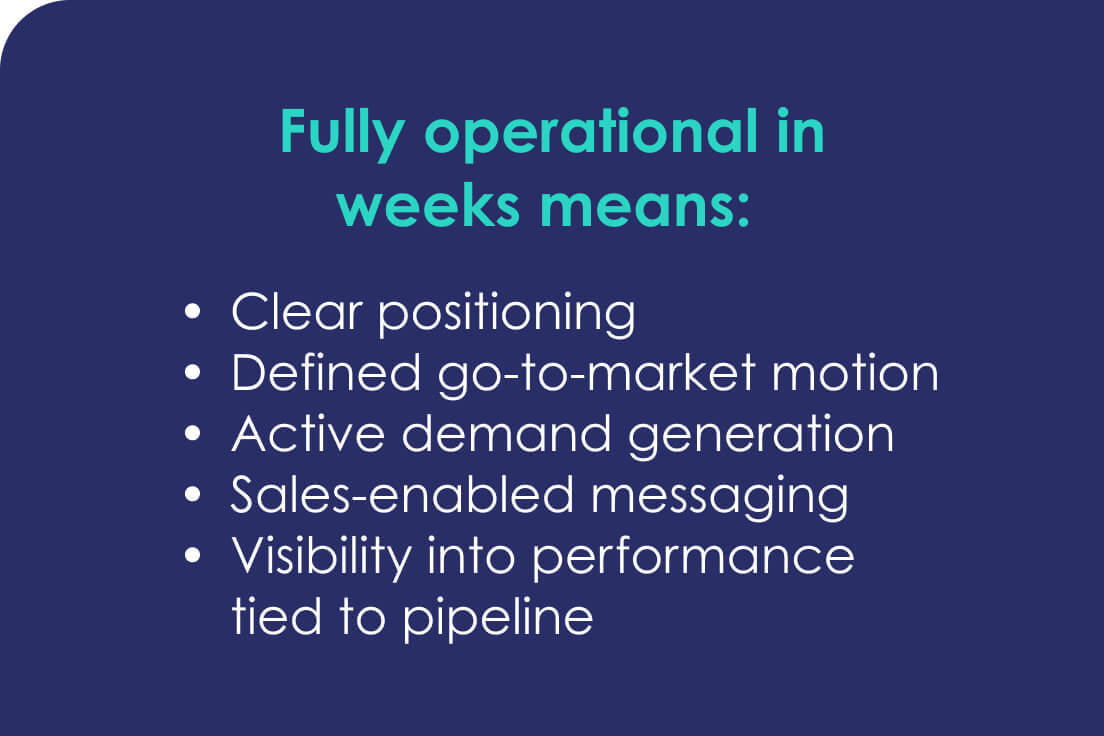
Fully operational means marketing is aligned, launched, and producing signal within weeks.
How is this possible when building out a team and setting up structures can take months? It starts with focus.
In the first phase, positioning is tightened for SaaS, data, and professional services companies serving life sciences tech. The buyer problem is clarified, and the value narrative is refined, so priority segments are defined.
This work is structured and time-bound. At the same time, go-to-market priorities are set. That includes:
Execution planning happens in parallel with strategy. Campaign architecture, messaging frameworks, and content direction are built alongside positioning work, so within weeks, campaigns move into market.
For companies selling into regulated healthcare buyers, precision matters and the messaging must build trust. Sales teams need language they can use immediately.
Demand generation launches with a clear hypothesis. Performance data is reviewed quickly, so adjustments are made based on real buyer response. Objections, deal friction, and common questions shape ongoing messaging and targeting.
Marketing Acceleration™ is the structured operating model developed by Rebound.
It was built for SaaS, data, and professional services companies serving life sciences and healthcare that need momentum without waiting to assemble a full internal team.
Rebound designed this model around a simple premise: growth stalls when strategy and execution are separated, and task-based outsourcing creates silos.
Marketing Acceleration™ combines three elements from the start:
Instead of separating strategy from implementation, both move together. Positioning informs campaigns, campaign performance informs positioning, and sales conversations refine messaging in real time.
Rebound applies this model in a structured, time-bound way. Positioning is clarified, and go-to-market priorities are defined, so demand generation launches quickly.
The result is a marketing function that operates as a system, not a collection of vendors or disconnected hires.
That system can later support internal team expansion, or it can continue operating as an integrated external capability. The key difference is that growth does not wait for headcount.
The objective is clear: activate coordinated momentum early and connect marketing activity directly to pipeline.
For SaaS, data, and professional services companies serving life sciences and healthcare, delays slow learning, pipeline, and revenue. Hiring role by role stretches momentum across quarters, while task-based outsourcing fragments execution.
Marketing Acceleration™ formalizes that approach. It provides structure, alignment, and speed without sacrificing clarity.
Ready to evaluate a marketing acceleration model for your team? Connect with us.
What is a marketing acceleration model?
A marketing acceleration model is an operating approach that activates strategy and execution at the same time. Instead of hiring one role at a time, it launches coordinated positioning, demand generation, and go-to-market activity within weeks.
How is a marketing acceleration model different from outsourcing marketing?
Outsourcing often focuses on specific deliverables such as paid media or content. A marketing acceleration model activates an integrated marketing function where strategy, messaging, and execution are aligned from the start.
Is a marketing acceleration model right for companies selling into life sciences and healthcare?
It is particularly relevant for SaaS, data, and professional services companies serving life sciences and healthcare. Regulated buyers require precision, strong messaging, and coordinated follow-up. An integrated model reduces fragmentation.
When should a company consider a marketing acceleration model instead of hiring?
Companies often consider it when hiring timelines are slowing growth, when pipeline needs to increase quickly, or when internal marketing efforts lack alignment with sales and revenue goals.

To make sure you get accurate and helpful information, this guide has been edited and fact-checked by the Rebound Editorial Team.