

Most life sciences tech companies say they care about marketing ROI metrics, but the numbers they track rarely explain whether marketing is helping the business move forward.
Lead counts, traffic, and campaign activity tend to dominate marketing dashboards. These metrics can show whether something happened, but they rarely explain whether marketing is improving how the company goes to market.
Research suggests that up to 95 percent of B2B buyers are not in market at any given time. When most potential buyers are not ready to purchase, lead volume alone becomes a weak signal of marketing impact.
For SaaS, data, and professional services companies serving life sciences and healthcare, the impact of marketing usually appears in quieter ways.
Sales teams begin using stronger messaging in real conversations, campaigns move faster once the team has clearer direction, and leadership gains better visibility into what the market responds to.
These signals often reveal more about marketing performance than lead reports alone.
One of the clearest marketing ROI metrics is how quickly a company can move from idea to launch. When marketing systems are working, campaigns, pages, and messaging do not sit in planning cycles for months. The team can develop an idea, build the supporting assets, and bring it to market while the opportunity is still relevant.
Speed matters because it shortens the distance between strategy and feedback. This shift becomes especially important in startup marketing for regulated healthcare markets, where companies are still refining how they explain their product and its role in the ecosystem.
Many teams start with a structured launch framework so they can move quickly while maintaining focus, similar to the approach outlined in this life sciences B2B SaaS marketing playbook. When marketing begins to accelerate execution across the organization, it is often an early sign that the system behind it is starting to work.
After speed improves, the next signal of marketing traction is momentum. This shows up through consistent output and work that continues to support the business long after it launches.
Many useful marketing ROI metrics focus on what the team actually produces over time. Deliverables such as messaging frameworks, sales decks, content programs, and campaign assets shape how the company communicates with the market. When these assets are developed thoughtfully, they continue supporting conversations, outreach, and pipeline generation across multiple deals.
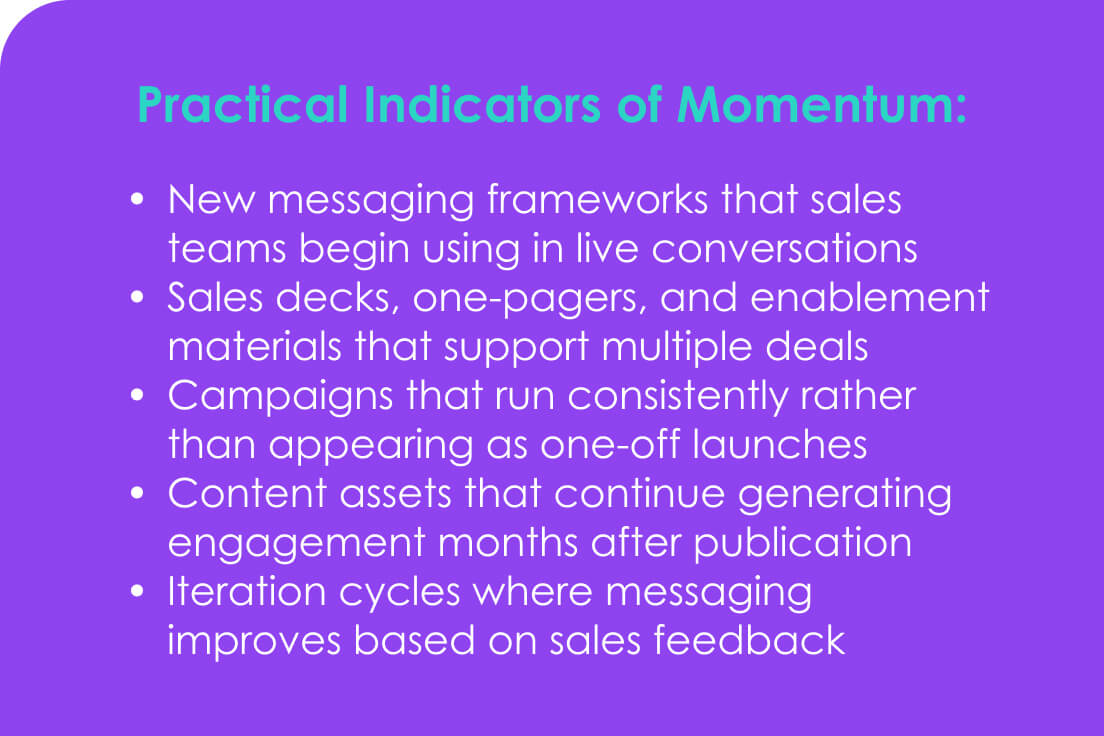
Momentum also grows through iteration. Teams refine messaging based on real conversations, adjust campaigns based on response, and strengthen the narrative as they learn what resonates with buyers.
For companies involved in B2B SaaS marketing and B2B messaging for regulated healthcare markets, this steady accumulation of usable assets often has a greater impact on growth than any single campaign.
Marketing ROI often becomes visible in pipeline before it appears in dashboards. The shift shows up in how deals move forward and how confidently sales teams engage buyers.
For companies focused on B2B demand generation for companies selling into life sciences and healthcare, this impact is especially important. Deals depend on clear positioning and supporting materials that help multiple stakeholders understand the problem and the solution.
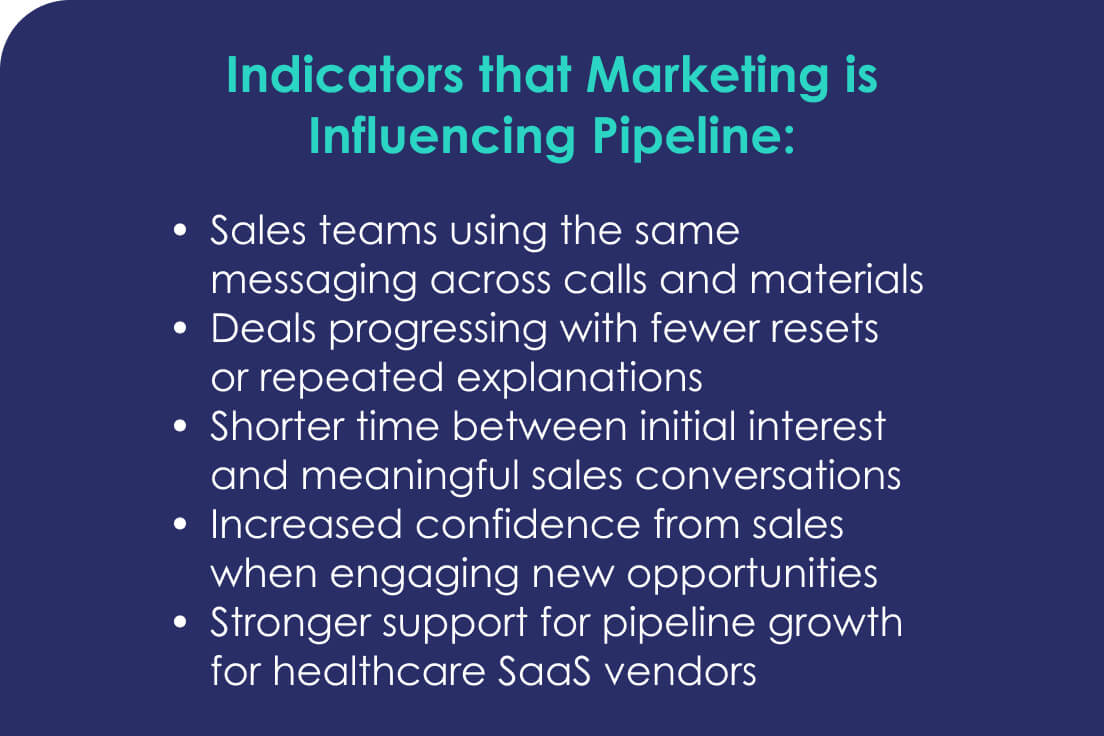
These changes do not always show up immediately in attribution models, but they often signal that marketing is improving how the business converts interest into real opportunities.
One of the clearest signs that marketing is working does not appear in a report, but it does show in how much time leadership gets back.
In many early-stage and growth-stage companies, founders and executives stay closely involved in messaging, sales materials, and positioning. But as marketing systems improve, this dynamic begins to change. Sales teams rely on shared messaging, materials hold up in real conversations, and fewer deals require executive intervention to move forward.
This is often where support from a fractional CMO for startups or a fractional marketing team creates the most visible impact. The goal is to build a system the company can rely on without constant executive involvement.
When leadership steps out of day-to-day messaging and deals continue to progress, it is a strong signal that marketing is creating real leverage.
At a certain point, the difference between teams that are growing and teams that are stuck comes down to visibility. Leadership needs to understand what is working, what is not, and why. Without that, decisions rely on assumptions, scattered data, or whatever metric looks strongest in a report.
For SaaS, data, and professional services companies serving life sciences and healthcare, this often shows up as a disconnect between marketing activity and business outcomes. Campaigns run, content gets produced, and leads come in, but it remains unclear how that work improves pipeline, messaging, or sales execution.
This is the problem Rebound is built to solve.
Rebound works with service providers to life sciences and healthcare and SaaS providers selling into healthcare and life sciences to build marketing systems that make performance easier to see and act on. That often starts with clearer positioning through brand and product marketing, followed by content marketing and demand programs that bring that messaging into market, and supported by marketing operations that connect activity to pipeline and revenue.
When these pieces are aligned, marketing becomes easier to evaluate. Teams can see which messages hold up in real conversations, which campaigns generate meaningful engagement, and how marketing supports sales across deals.
Which leads to a more useful question.
Are you measuring the metrics that actually show progress, or just the ones that are easiest to report? If you’re ready to connect marketing performance to pipeline, messaging, and real sales outcomes, let’s talk.

Q1: What are the most useful marketing ROI metrics for life sciences tech B2B companies?
The most useful marketing ROI metrics show how marketing improves execution across the business. This includes speed to launch, how often sales uses marketing assets, how messaging performs in real conversations, and how marketing supports pipeline progression.
Q2: Why are leads considered vanity metrics in B2B marketing?
Lead counts can show activity, but they do not always reflect deal quality or sales progress. Many teams generate leads that never turn into meaningful conversations or qualified opportunities, which makes lead volume an incomplete measure of performance.
Q3: How can life sciences tech companies measure marketing traction earlier?
Early traction often appears through operational signals. Teams launch campaigns faster, messaging becomes more consistent, and sales relies more on shared materials. These changes usually happen before revenue impact becomes visible in reports.
Q4: What role does marketing play in pipeline growth for companies selling into healthcare?
Marketing supports pipeline growth by improving how the company communicates its value. Clear positioning, strong messaging, and effective sales materials help deals move forward and make it easier for buyers to understand the solution.
Q5: What does strong marketing performance look like beyond dashboards?
Strong performance shows up in how the business operates. Campaigns move quickly, teams align around a clear narrative, and sales conversations become more effective. These signals often provide a more accurate view of impact than isolated metrics.

To make sure you get accurate and helpful information, this guide has been edited and fact-checked by the Rebound Editorial Team.