
Most ABM programs assume one thing: Your audience is online, trackable, and responsive to digital touchpoints.
That assumption breaks down fast in regulated healthcare tech markets.
If you’re doing B2B marketing for companies selling into life sciences and healthcare, you’ve likely seen this firsthand. As campaigns run, KPIs like impressions may look fine, but engagement is thin, and the pipeline from key accounts is inconsistent.
This is a sign that the issue isn’t necessarily in the execution, but the audience’s reality.
Many of the stakeholders that matter most in these deals are hard to reach through standard digital channels. Senior clinicians, regulatory leaders, procurement teams, and field-based medical stakeholders do not behave like typical B2B buyers. They are not spending time clicking on ads or filling out forms. And in many cases, they are actively shielded from digital outreach.
At the same time, privacy and compliance constraints continue to limit visibility. Regulations like HIPAA and internal hospital policies restrict how data can be collected and used. This reduces the effectiveness of intent-based targeting, which many ABM programs depend on.
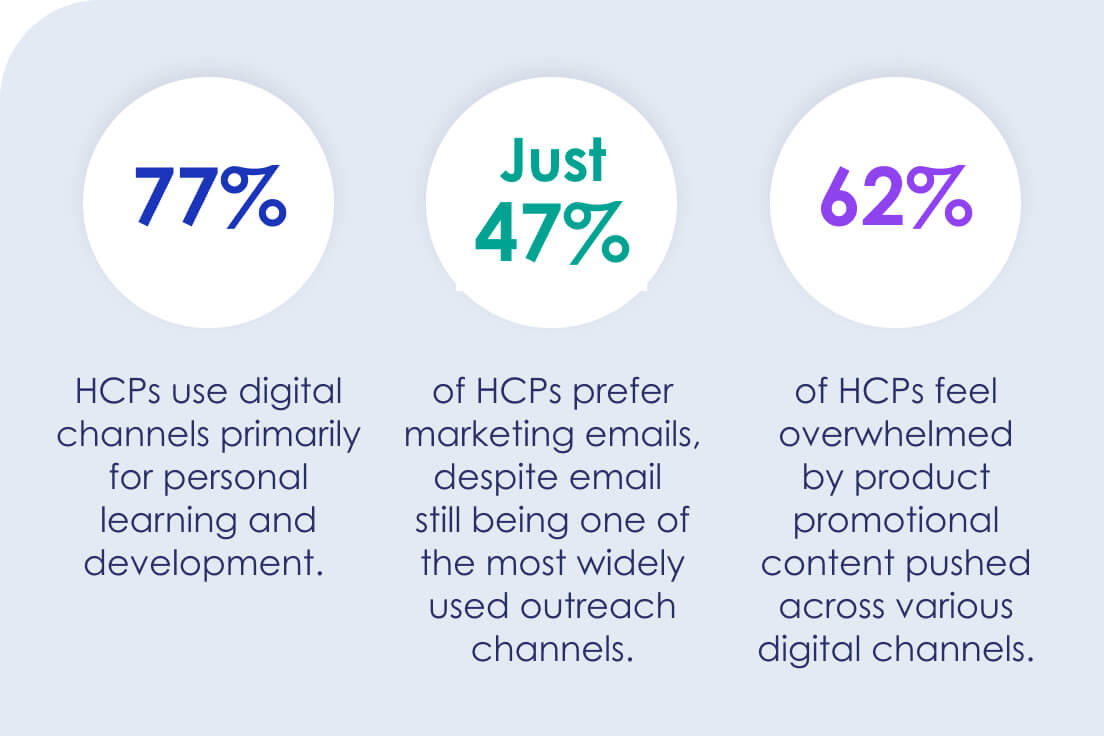
There is also a clear mismatch between how companies reach these audiences and how they prefer to engage. Only 47% of HCPs prefer receiving communication through marketing emails, even though email remains one of the most common outreach channels.
So while digital channels are available, they are not working the way most ABM programs expect.
What you get is limited signal, low response rates, and buying activity that happens outside of measurable channels. But the answer is not to abandon ABM in life sciences tech entirely– it’s to adjust how it works.
For SaaS, data, and professional services companies serving life sciences and healthcare, effective ABM requires a different model. One that blends digital with offline touchpoints. One that accounts for limited visibility, and one that aligns marketing, sales, and medical teams around the same accounts.
In this guide, we’ll walk through seven ABM playbooks to help you reach hard-to-reach life sciences buyers. These playbooks reflect how clinicians, regulatory stakeholders, and procurement teams actually engage across hybrid, offline, and rep-enabled channels.
Most ABM programs are built around what is easy to track, like ads, clicks, visits, and form fills. However, that model does not necessarily hold up in regulated healthcare markets.
If you want to reach clinicians, regulatory stakeholders, or procurement teams, you need to design around how they actually engage. That means building programs that extend beyond digital and into controlled, real-world environments.
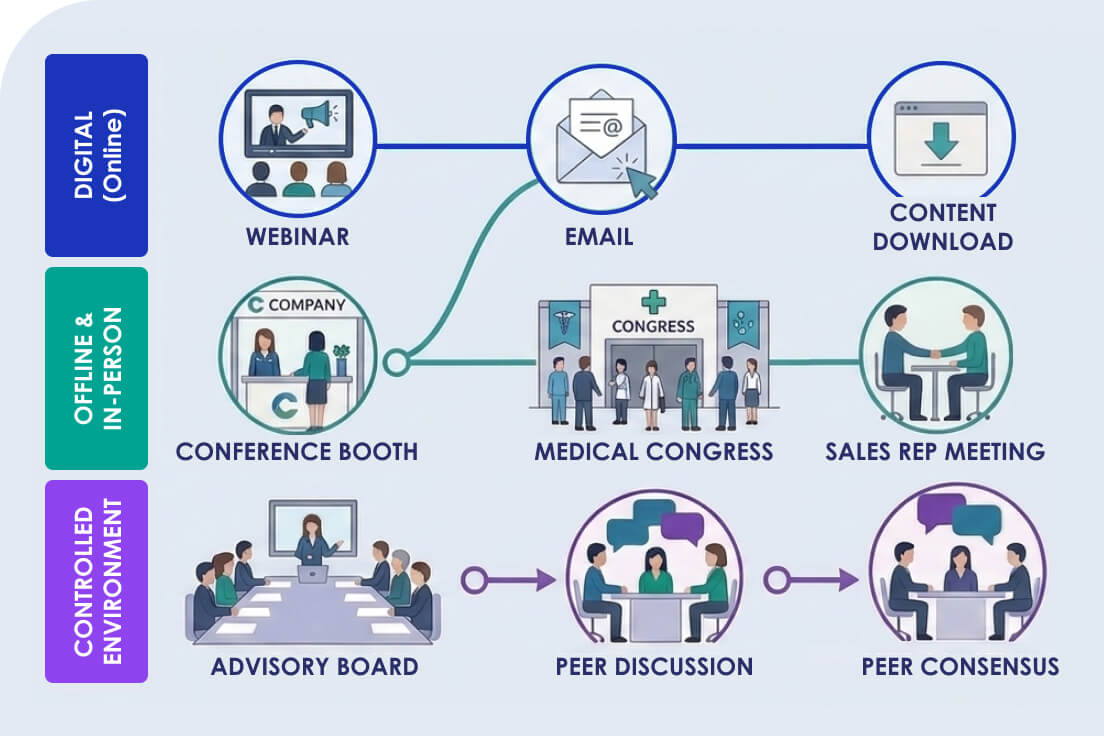
For teams focused on B2B marketing for companies selling into life sciences and healthcare, this is where ABM shifts from campaign execution to coordinated account orchestration.
For many hard-to-reach audiences, conferences are more than just awareness channels. They are primary engagement environments.
Clinicians and medical leaders often concentrate their industry activity around congresses, symposia, and specialty events. These moments create rare windows where access is possible.
But most teams treat events as standalone tactics. They sponsor a booth, run a few meetings, and move on.
A better model treats each event as part of an account-specific engagement plan.
Start with congress strategy tied to target accounts. Identify which stakeholders from your priority accounts are likely to attend. Map their roles, interests, and affiliations. Then build pre-event outreach that sets up relevance before the event even starts.
During the event, focus on structured, small-group interactions instead of broad exposure. Private meetings, roundtables, and curated discussions create more meaningful engagement than high-volume booth traffic.
After the event, follow-up matters more than the event itself. This is where most programs drop off.
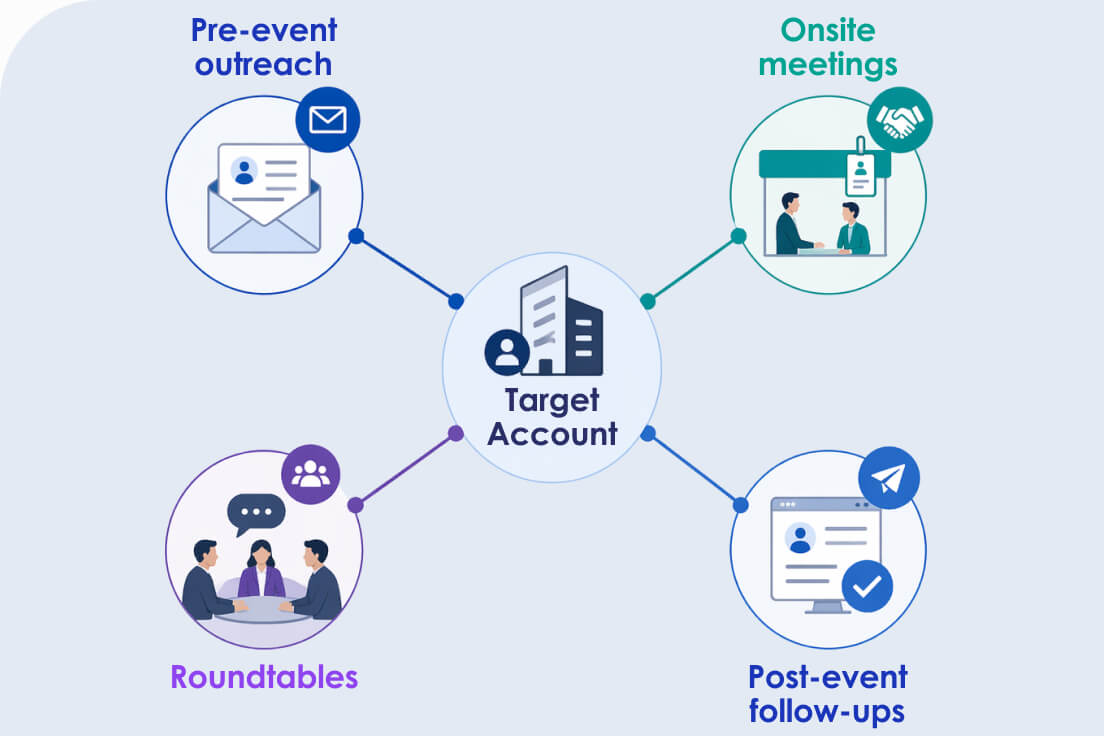
Field teams should have clear next steps tied to each interaction. That could include tailored content, follow-up meetings, or internal account mapping. Without this layer, event engagement does not translate into pipeline.
Hard-to-reach audiences are selective. They spend time in environments they trust, and those environments are often not open digital channels.
According to a report from McKinsey, 60% of healthcare professionals prefer a mix of in-person, remote, and digital interactions, with no single channel dominating engagement. In practice, this means digital channels alone rarely drive meaningful engagement.
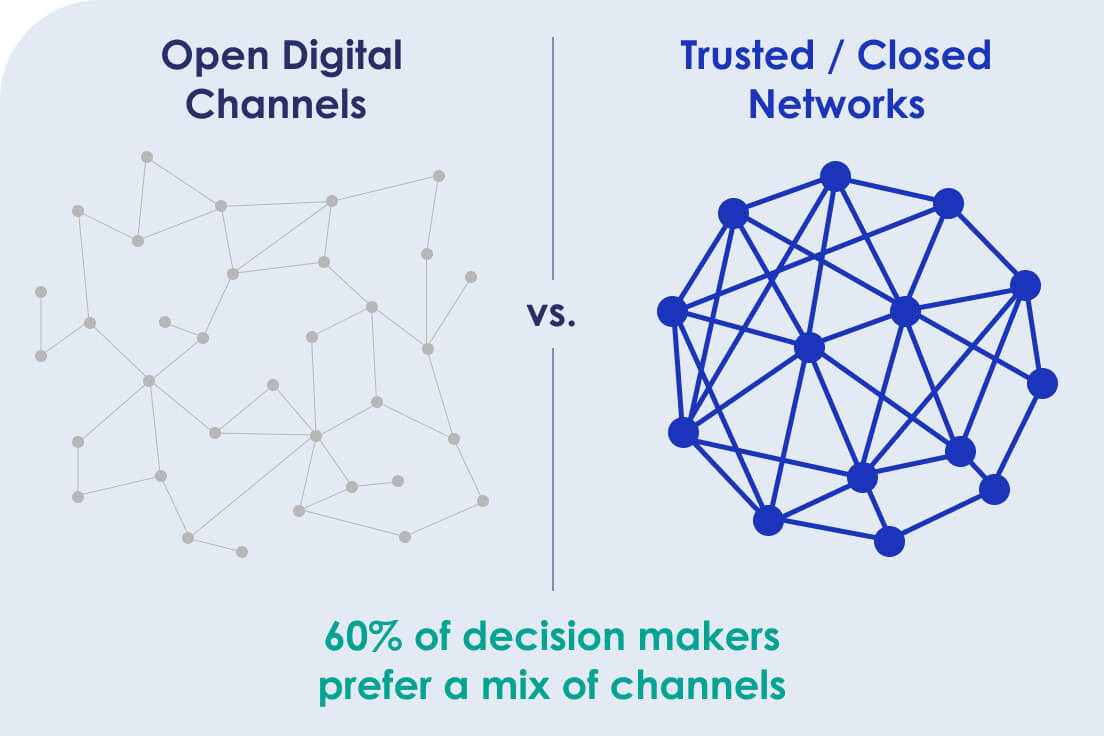
Healthcare professionals rely heavily on closed or semi-closed networks for information and peer interaction. These include medical communities, professional forums, and trusted content platforms. They also rely on known sources like journals and peer networks rather than vendor-owned channels.
Instead of relying only on paid media, teams should invest in presence within trusted ecosystems. That could include partnerships with professional communities, placements in relevant publications, or participation in peer-driven environments.
At the same time, some of the most effective channels are not new, they are just underused.
Email still plays a role, but it needs to be reframed. A report from Indegene shows that only 47% of HCPs prefer marketing emails, which suggests that generic campaigns are easy to ignore. But targeted, rep-enabled outreach tied to known relationships performs differently.
This is where rep-enabled channels become critical.
Sales and medical teams often have access that marketing does not. When outreach is coordinated and supported with relevant content, these interactions become far more effective than standalone campaigns.
In many organizations, marketing runs campaigns, sales manages relationships, and medical teams engage on scientific topics. Each function operates with its own goals and timelines.
That structure creates gaps, and hybrid ABM only works when teams operate as one system.
Hard-to-reach audiences do not respond to isolated touchpoints. They do respond to consistent, relevant engagement across channels. And considering the average sales cycle for the industry lasts between 8-12 months, these audiences require multiple touches with numerous people within the organization.
This is where multi-channel air cover becomes important.
Instead of thinking in terms of campaigns, think in terms of coordinated pressure across the same accounts. While a clinician is attending a conference, they may also receive a follow-up from a field rep, see relevant content in a trusted publication, and be invited to a peer discussion.
Each touchpoint reinforces the others. But to make this work, teams need shared visibility and shared triggers.
This is where CRM systems should play a central role. Not just as reporting tools, but as coordination layers.
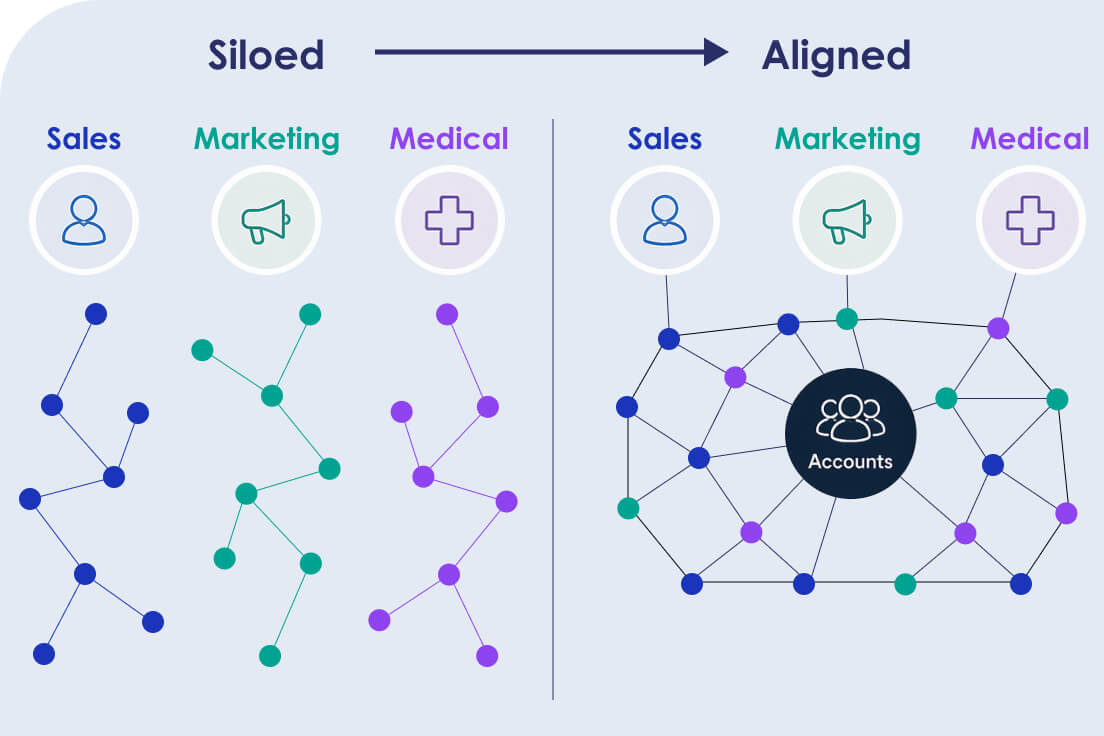
CRM-triggered engagement allows teams to act on real-world signals.
For example:
For organizations building a go-to-market strategy for healthcare SaaS vendors, this level of alignment is often the difference between fragmented outreach and sustained account engagement.
It also changes how success is measured, because it requires looking beyond the typical vanity metrics. This shift is necessary when the buying process is not visible through standard digital signals. Instead of simply optimizing for clicks or conversions, teams should track account progression, relationship depth, and engagement across multiple stakeholders.
Most ABM strategies rely on intent data, but that breaks down in regulated healthcare markets.
This audience is not always leaving consistent digital signals by filling out forms or clicking ads. If you wait for intent data, you miss the buying window.
For teams doing B2B marketing for life sciences and healthcare service providers, segmentation needs to shift from observed behavior to inferred relevance.
If you cannot track behavior, look at what people do in their roles. Some signals are more reliable than digital engagement.
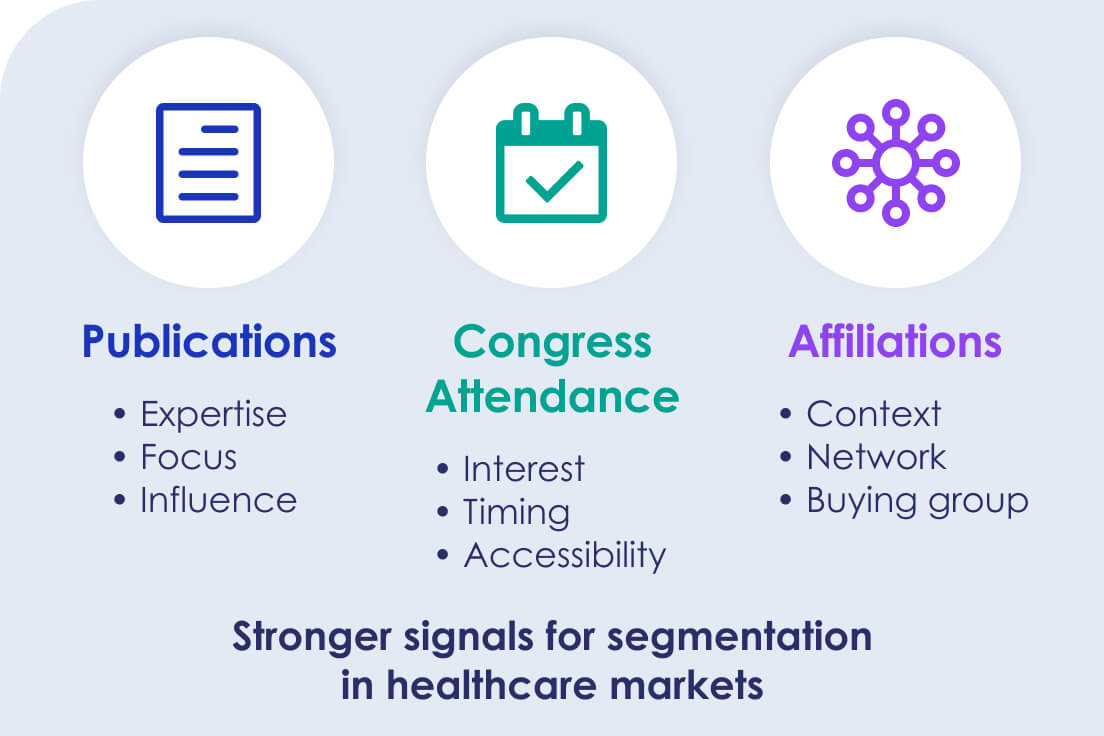
These signals reflect how these audiences operate. Healthcare professionals engage through structured learning, peer networks, and professional environments, not vendor-driven channels, which makes them stronger inputs for targeting.
In most ABM programs, account tiering is driven by engagement scores. But when engagement data is limited, that model falls apart. Therefore, the data needs to be prioritized.
Start by separating accounts into two broad groups:
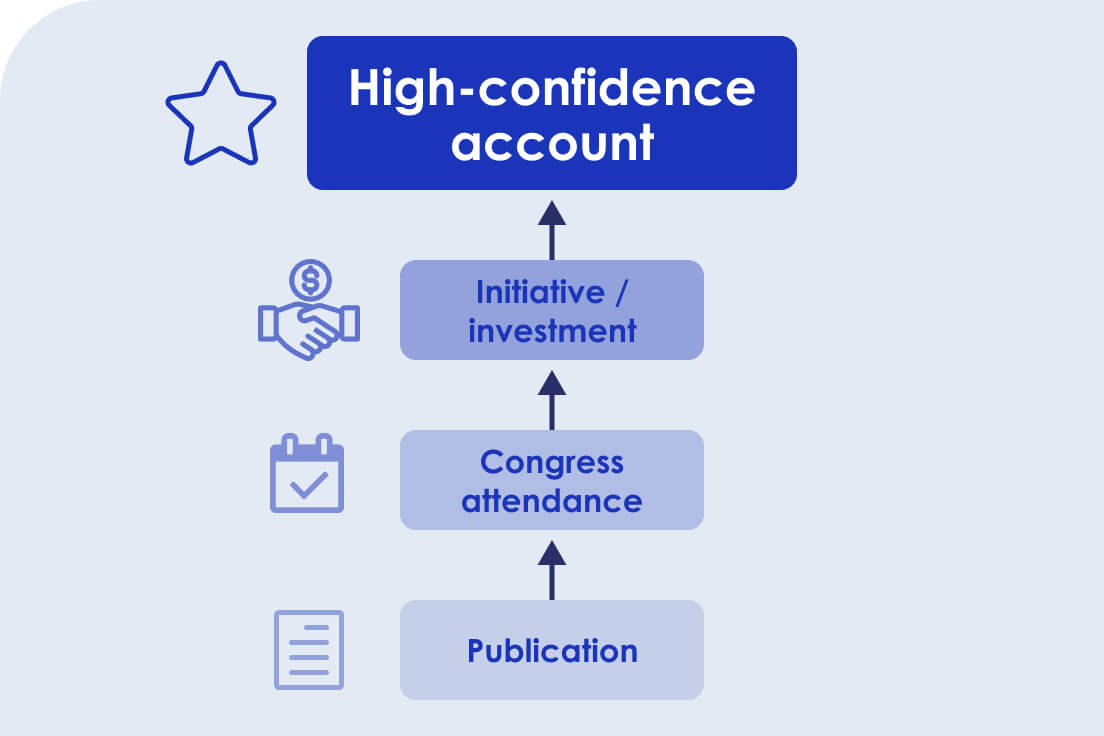
This is where signal stacking becomes useful.
Instead of relying on one data point, combine multiple weak signals to build confidence. For example:
Individually, each signal is incomplete. Together, they create a clearer picture.
This approach allows you to prioritize accounts even when direct engagement data is missing. It also helps avoid overvaluing accounts that happen to click but are not a strong fit.
When you cannot rely on engagement data, you need another way to understand the account. That usually comes from people, not platforms.
Sales and medical teams often have information that does not exist in any platform. They know which stakeholders are influential, what concerns are coming up in conversations, and how decisions are being made.
That insight needs to be captured and shared. The most effective approach is to combine qualitative insight with field input.
CRM systems can support this, but only if they are used as active intelligence layers rather than passive databases. Notes, meeting outcomes, and stakeholder updates should feed back into account plans.
Over time, this creates a more complete view of each account.
For teams building B2B marketing for companies selling into life sciences and healthcare, the goal is not perfect visibility. It is better-informed decisions with limited data.
Healthcare stakeholders are busy, selective, and often access information through controlled channels or direct interactions. For teams doing B2B marketing for companies selling into life sciences and healthcare, content needs to work in those conditions.
Healthcare audiences filter out promotional content. 62% of HCPs feel overwhelmed by it, which reduces engagement.
What works is content that is more straightforward and evidence-based:
Format is what gets attention, but the messaging determines whether it sticks.
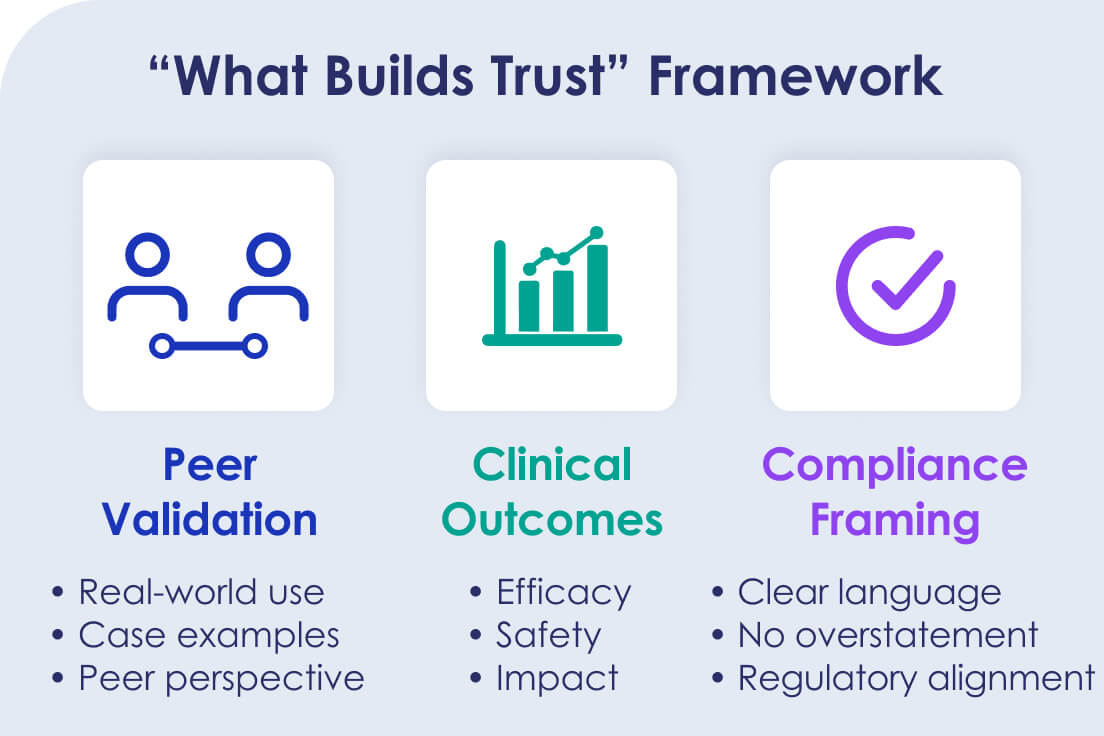
A strong content strategy for medtech vendors needs to start with context:
What does the audience need to do differently? Where does your solution fit into their workflow?
Content should answer those questions directly by using practical examples tied to real workflows. Show how something works in a clinical setting and how it fits into existing processes. Keep it grounded and realistic.
It also means aligning content with the channels discussed earlier. A PDF used in a follow-up meeting should connect to a conversation at a conference. A slide deck should support a rep discussion, not replace it.
Reaching hard-to-access stakeholders requires coordination across channels, teams, and time. Without a system, even strong programs break down.
For teams doing B2B marketing for companies selling into life sciences and healthcare, the goal is to turn isolated efforts into a repeatable model.
First, there is an over-reliance on digital. Teams invest in channels that are easy to scale but do not reach key stakeholders.
Second, there is a lack of alignment. Marketing runs campaigns. Sales works relationships. Medical engages separately. The account experiences each interaction in isolation.
That leads to fragmented engagement and missed opportunities. Even strong teams struggle here because the model they are using was not built for regulated healthcare markets.
When to Bring in a Specialized Partner
At a certain point, the gap is not effort. It usually comes down to the structure and experience of the team or leadership.
This is where a specialized partner can help.
Rebound works with SaaS, data, and professional services companies serving life sciences and healthcare to build ABM programs that reflect how these markets actually operate.
That often starts with fractional leadership.
A fractional CMO can help define the go-to-market model, align teams, and prioritize the right accounts. This is especially useful for companies that need senior strategy without building a full in-house team.
Rebound also provides modular marketing teams that plug into specific areas like content, demand generation, and marketing operations. These teams are built for B2B SaaS marketing in regulated healthcare markets, where coordination matters more than channel volume.
For companies looking for a B2B SaaS marketing agency that understands how to reach hard-to-engage healthcare audiences, that system is what drives consistent pipeline.
If you are trying to improve pipeline with hard-to-reach accounts, it may be time to rethink how your ABM program is designed.
Whether you need a fractional CMO for startups, a fractional marketing team, or support across content, demand generation, and marketing operations, Rebound help teams turn disconnected efforts into a system that drives real engagement.
If this is a priority for your team, connect with Rebound to build a marketing approach that reflects how these markets actually work.

Q1: Why does ABM struggle in healthcare and life sciences?
A: ABM struggles in healthcare and life sciences because key decision-makers, such as clinicians, regulatory leaders, and procurement teams, are often not active on trackable digital channels. In addition, strict privacy regulations like HIPAA limit data collection and targeting. As a result, traditional intent-driven ABM strategies lack visibility and fail to capture real buying activity.
Q2: How can you reach clinicians and healthcare stakeholders with B2B marketing?
A: To reach clinicians and healthcare stakeholders, B2B marketing teams need to use a hybrid approach that includes conferences, field engagement, trusted networks, and rep-enabled outreach. These channels align with how healthcare professionals prefer to engage through peer interactions, controlled environments, and relationship-driven communication.
Q3: What is a hybrid ABM strategy in regulated healthcare markets?
A: A hybrid ABM strategy in healthcare combines digital, offline, and field-driven engagement into a coordinated account-based program. Instead of relying only on ads and form fills, it integrates conferences, sales outreach, and trusted channels to engage stakeholders across multiple touchpoints and improve account-level visibility.
Q4: How do you segment accounts without intent data?
A: To segment life sciences accounts without intent data, marketers use proxy signals such as scientific publications, congress attendance, institutional affiliations, and hiring trends. These insights are combined with input from sales and medical teams to prioritize high-value accounts based on relevance rather than digital behavior.
Q5: What content formats work best for low-digital engagement audiences?
A: The most effective content for low-digital healthcare audiences includes portable, rep-enabled formats such as PDF briefs, slide decks, and case studies. These formats are easy to share in meetings, conferences, and follow-ups, and they support relationship-driven engagement rather than relying on inbound digital conversion.
To make sure you get accurate and helpful information, this guide has been edited and fact-checked by the Rebound Editorial Team.