
Every week I talk to CEOs who are under pressure to grow. Some have just closed a round of institutional investment. Others are navigating a merger or acquisition, or operating under a private equity firm that has just taken a position. The trigger varies. The urgency is always the same.
And the first thing most of them say to me is some version of: “I need to hire.”
I understand the instinct. When growth expectations accelerate, adding people feels like the most direct path to results. It signals to the board that you’re moving. It feels like progress.
But in my experience, hiring before you’ve built the right structure doesn’t accelerate growth. It accelerates whatever you already have, including the problems.
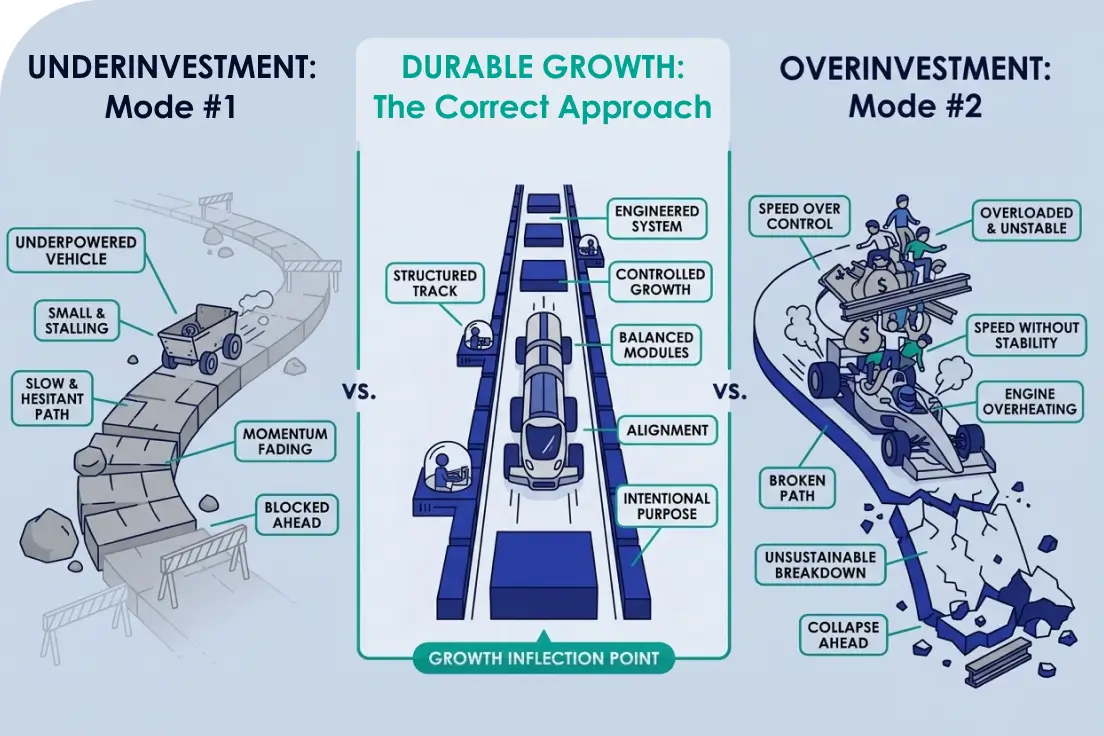
Companies navigating a growth inflection point tend to make one of two mistakes.
The first is underinvesting. They move too cautiously, wait too long to build capability, and slow their own growth at exactly the moment the market is ready for them. The board grows impatient. Momentum stalls.
The second is overinvesting. They scale headcount and spend before the model is proven, lock in fixed cost structures the business can’t sustain, and find themselves restructuring eighteen months later wondering what went wrong.
Both are failure modes. And both are more common than most leadership teams want to admit.
The companies that navigate this well tend to do something different. They don’t ask how fast should we hire. They ask how do we build the right structure so that investment actually produces durable growth.
That’s a harder question to answer, but it’s the one that needs to be asked.
Scaling used to be relatively straightforward. You hired salespeople to sell, marketers to market, and finance people to track the numbers. Headcount was the primary unit of organizational growth.
That model is breaking down.
AI is compressing the cost of execution across every function: product development, finance, and go-to-market. Teams that used to require twelve people are operating effectively with seven. The headcount assumptions that boards and leadership teams have been using for years are increasingly disconnected from what’s actually required to get work done.
At the same time, the marketing and content models that companies have relied on for growth are being disrupted. Sixty percent of Google searches now end without a click to a website. When an AI summary appears at the top of a search result, click-through rates drop by nearly half.
HubSpot, arguably the gold standard in content marketing for over a decade, lost between seventy and eighty percent of its organic traffic between 2024 and 2025. If it can happen to them, it can happen to anyone scaling a content strategy without the right foundation underneath it.
Scaling is no longer just about adding headcount. It is about designing a flexible operating model, one that builds the right capability at the right time, preserves financial flexibility, and can evolve as the business evolves.
Here is where I see companies make a critical mistake on the go-to-market side specifically.
When growth pressure hits, the reflex is to start executing: more campaigns, more content, more sales activity. But execution without foundation doesn’t produce growth. It produces noise.
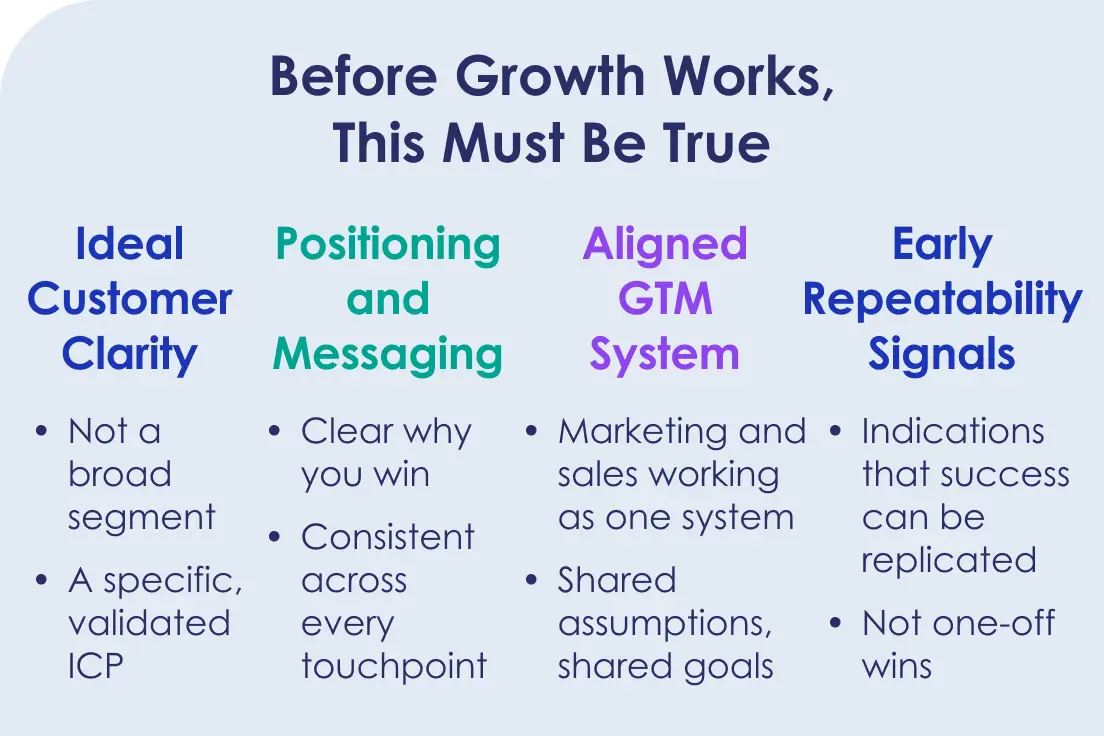
Before any of that activity can work, a few things need to be true. You need clarity on who you are actually selling to, not a broad segment, but a validated and specific ideal customer profile. You need positioning and messaging that consistently communicates why you win. You need marketing and sales operating as a coordinated system, not as separate functions working off different assumptions. And you need to start seeing early signals that what you’re doing is becoming repeatable.
There is also a transition that most early-stage companies underestimate: moving from founder-led sales to a commercial team. When the founder is selling, the pitch lives in one person’s head. It is instinctive, flexible, and deeply personal.
But the moment you add salespeople, that pitch needs to be codified. Every rep needs to be able to tell the same story consistently. If the positioning and messaging aren’t in place before you make those hires, every rep tells a different version. That is a sign of a missing marketing foundation.
At Rebound, this is the work we do before we do anything else. Not because it is the most exciting part of building a go-to-market engine, but because nothing else works without it.
Once the foundation is in place, the question becomes how to build the capability to execute against it without taking on more fixed cost than the business can support at this stage.
This is where the flexible operating model concept becomes practical rather than theoretical.
A mature marketing organization requires many different skill sets: brand strategy, demand generation, content, product marketing, digital, sales enablement, analytics, and operations. Most companies at the growth stage don’t have the budget for all of those roles, and they shouldn’t, because not all of them are needed at the same time.
The traditional answer has been to hire sequentially and hope the timing works out. The problem is that building even a small marketing team through traditional hiring takes six to nine months minimum. Most companies under growth pressure don’t have that runway.
The better question is: what capability do we actually need right now, for this stage of growth, and do we need to own it permanently, or can we access it in a way that preserves flexibility?
At Rebound, we built our model around that question. We work with companies to stand up a full marketing organization quickly, one that is already operating in their market, already understands their buyer, and can start executing immediately. The skills deployed bend and flex with the business as it evolves, rather than locking in a fixed org structure that has to be unwound when priorities shift.
The goal is always the same: the right skills, in the right seats, at the right time, for the right duration, driving the right business outcomes.
If you are navigating a growth inflection point right now, whether that is a new round of capital, a merger, a PE event, or simply a board that is expecting more, the most important question you can ask is not how fast should we hire.
It is: are we actually structured to scale?
Do you have the commercial foundation in place? The financial visibility to make confident decisions? An operating model that builds capability without locking in cost you can’t sustain?
If the answer to any of those is no, more hiring won’t fix it. It will just make the gap harder to close.
Building the foundation comes first, and that’s where we focus. Connect with Rebound to see how we help companies structure for durable growth.

Q1: How does a go-to-market strategy support scalable growth?
A: A strong go-to-market strategy creates the foundation for repeatable growth by aligning ICP, messaging, and execution, making it easier to scale without relying solely on headcount.
Q2: Why is hiring more people not enough to scale a go-to-market strategy?
A: Without a clear go-to-market strategy, hiring more people can amplify inefficiencies. Growth comes from structured systems and alignment, not just adding resources.
Q3: What are the biggest go-to-market strategy mistakes companies make?
A: Common mistakes include scaling before product-market fit, unclear positioning, misaligned sales and marketing teams, and overinvesting in headcount too early.
Q4: What foundation is required for an effective go-to-market strategy?
A: An effective go-to-market strategy requires a clearly defined ICP, strong positioning, consistent messaging, and alignment between marketing and sales teams.
Q5: How is AI impacting go-to-market strategy today?
A: AI is making go-to-market strategies more efficient by reducing execution costs, enabling smaller teams to achieve more, and shifting focus toward strategy and systems.
Q6: What is a flexible operating model in go-to-market strategy?
A; A flexible operating model allows companies to access the right capabilities at the right time without committing to full-time hires, improving efficiency and adaptability.
Q7: How do you transition from founder-led sales to a scalable go-to-market strategy?
A; To transition successfully, companies need to codify messaging, define sales processes, and ensure consistency so new team members can replicate success.
Q8: How can companies scale marketing without increasing headcount?
A: Companies can scale by leveraging AI, outsourcing specialized roles, and focusing on systems and processes that improve efficiency rather than adding full-time staff.
To make sure you get accurate and helpful information, this guide has been edited and fact-checked by the Rebound Editorial Team.