

For many health tech startups, raising capital triggers the same response: hire a VP of Marketing or a CMO. Someone who can help the company hit ambitious growth targets and satisfy investor expectations.
On paper, it makes sense. In practice, it just creates a new problem.
Most senior marketing hires take six to nine months to reach full productivity, and they still need specialists across content, demand generation, product marketing, marketing operations, and analytics to execute effectively.
The gap between the hire date and meaningful pipeline contribution is longer than most leadership teams expect. The question is no longer if your company needs marketing leadership, but whether a traditional full-time hire is the fastest path to growth.
For many health tech startups, the answer is no.
The biggest mistake founders make is assuming they have a staffing problem when what they actually have is a go-to-market problem.
When growth slows, the instinct is to add resources and employees. But headcount only works when there is a repeatable system for those people to operate within.
What gets a company to $1M ARR is rarely what gets it to $10M. Early growth is usually built on founder relationships, referrals, industry expertise, and sheer persistence. Those motions generate traction, but they do not scale.
Before investing in marketing headcount, founders need to know whether their GTM motion is actually repeatable. A few honest questions can reveal a lot:
If those answers are unclear, adding people isn’t the solution. It will just add cost to a system that has not been fully built.
Most startups shouldn’t hire a full-time CMO as their first marketing hire.
The data backs this up: CMOs have the shortest tenure in the C-suite, averaging just 14 to 25 months. That turnover is not random. It reflects a structural mismatch.
A full-time CMO built for scaling an established company often struggles in an environment where the ICP is still being refined, the messaging hasn’t been validated, and the sales motion isn’t fully defined yet. They were hired to scale a system, but they arrive to find the system doesn’t exist yet.
There is also a capability gap that rarely gets discussed upfront. A single marketing leader, no matter how experienced, cannot credibly cover positioning, demand generation, content, marketing operations, and sales enablement at the same time.
By the time a company recognizes the mismatch, they have spent months and significant budget finding out. Replacing a senior hire compounds the cost further, in time, in recruiting fees, and in lost momentum.
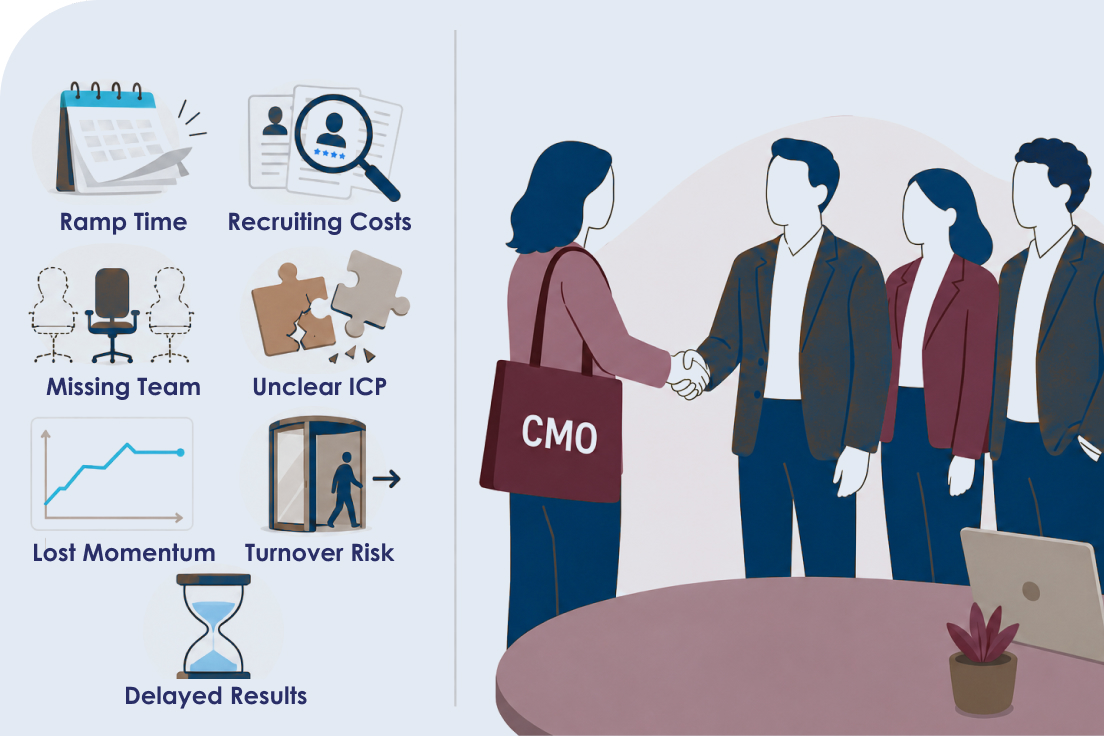
A fractional CMO for startups gives companies access to strategic marketing leadership and specialized execution resources without the cost and commitment of building a full in-house department.
Modern marketing requires a diverse set of capabilities, including strategy, product marketing, content creation, demand generation, marketing operations, analytics, and sales enablement. A single hire may bring expertise in one or two areas, but no one person can execute across all of them effectively.
That gap becomes harder to ignore as a company scales. A strong marketing leader without the right specialists around them can set direction but struggle to execute.
A fractional marketing team solves this by bringing in specialized expertise when and where the business needs it, without the overhead of building a full team before the timing is right.
For companies selling into healthcare and life sciences, getting marketing right takes longer than most founders expect. Not because the work is harder, but because the market is harder to learn.
Buyers in this space are technical, skeptical, and operate inside complex organizations. Most agencies, contractors, and new hires will not have a firm grasp on this from day one. The result is months spent educating rather than executing, with time and budget absorbed by a learning curve.
A fractional team with deep healthcare and life sciences experience skips that phase since the market knowledge is already there. That matters most for companies with niche or highly technical offerings, where a generic marketing approach will not cut it.
One quarter, the priority may be refining messaging and positioning. The next, it may be building thought leadership content, launching demand generation campaigns, improving marketing operations, or creating sales enablement materials.
Rather than hiring multiple full-time employees to fill those roles, companies can tap into the right capabilities as their needs evolve.
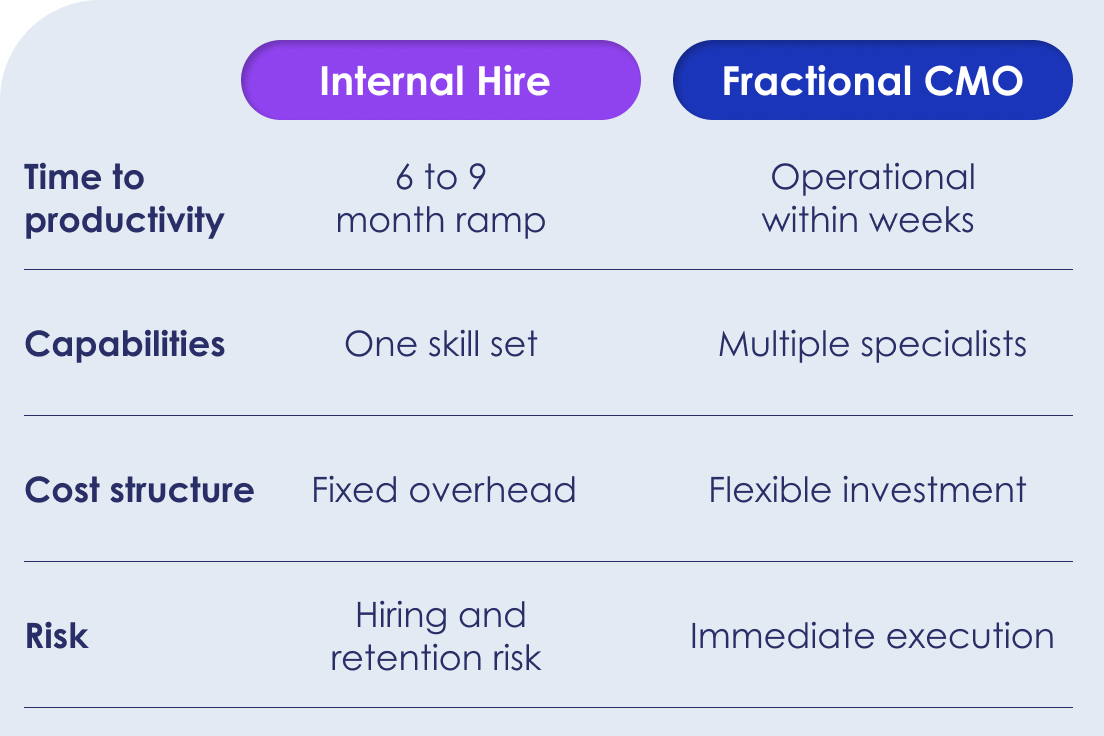
Adding marketing resources before the business is ready to absorb them rarely produces the results companies are looking for. Before expanding the team, founders should be able to answer yes to most of these questions:
If several of these answers are unclear, the priority is building the system, not expanding the team.
Rebound is a B2B life sciences and health tech marketing agency offering fractional CMO leadership and full-team execution through its Marketing Acceleration™ model.
Marketing Acceleration™ gives companies access to strategic leadership and specialized execution across positioning, demand generation, content, account-based marketing, sales enablement, and marketing operations, with resources that flex as the business grows. Rather than building an in-house department before the timing is right, companies get the right capabilities at each stage.
Rebound works with healthcare SaaS vendors, life sciences service providers, and technology companies selling into regulated markets. Because our teams understand the industry, buyer landscape, and commercial challenges from the start, clients focus on execution rather than onboarding.

What is a fractional CMO?
A fractional CMO is a part-time or outsourced chief marketing officer who provides strategic marketing leadership without the cost or commitment of a full-time executive hire. Fractional CMOs typically work across multiple companies at once, bringing senior-level expertise at a fraction of the cost of a full-time role.
What does a fractional CMO do for a startup?
A fractional CMO sets marketing strategy, defines the ICP and messaging, aligns sales and marketing, and oversees execution across channels. For early-stage startups, they often serve as the first marketing leader, building the GTM system before the company is ready to hire a full-time team.
What is the difference between a fractional CMO and a marketing agency?
A fractional CMO operates as an embedded strategic leader inside the company, owning marketing direction, building the team, and being accountable for results. A marketing agency typically executes specific services such as content, ads, or SEO without taking strategic ownership. Rebound combines both: fractional CMO leadership paired with a specialist execution team.
What is a fractional marketing team?
A fractional marketing team provides access to strategic marketing leadership and specialized execution resources on a part-time or outsourced basis. Instead of hiring a full in-house department, companies can leverage experts in areas such as positioning, content, demand generation, marketing operations, and analytics as needed.
When should a health tech startup hire a full-time CMO?
A full-time CMO often makes sense when a company has a proven go-to-market strategy, repeatable revenue growth, and enough marketing complexity to justify building an internal team. Earlier-stage companies may benefit more from a fractional model that provides flexibility and access to a broader range of expertise.
What are the benefits of a fractional marketing team?
A fractional marketing team gives companies access to specialized expertise without the cost and risk of hiring multiple full-time employees. It also provides flexibility to scale resources up or down as business priorities change.
How can Rebound help health tech and life sciences companies scale?
Rebound’s Marketing Acceleration™ model helps healthcare SaaS vendors, life sciences service providers, and technology companies selling into regulated markets build repeatable go-to-market systems. Services include messaging and positioning, content marketing, demand generation, account-based marketing, sales enablement, marketing operations, and analytics.

To make sure you get accurate and helpful information, this guide has been edited and fact-checked by the Rebound Editorial Team.