
Most life sciences technology startups get their first deals the same way: the founder knows people, believes in the product, and makes things happen.
The founder lands the first customers through industry relationships, product expertise, and persistence. They know the market better than anyone. They can explain the product vision, navigate technical conversations, and build trust with early adopters.
But at some point, the hustle stops compounding and starts limiting.
At this stage, many CEOs assume the solution is hiring a marketing leader or building a larger team. The challenge is often bigger than staffing. The company needs a repeatable go-to-market system that can scale beyond the founder’s network and personal involvement.
Founders are often the best salespeople a company will ever have. They carry deep product knowledge, a compelling vision, and personal credibility that sales hires rarely replicate.
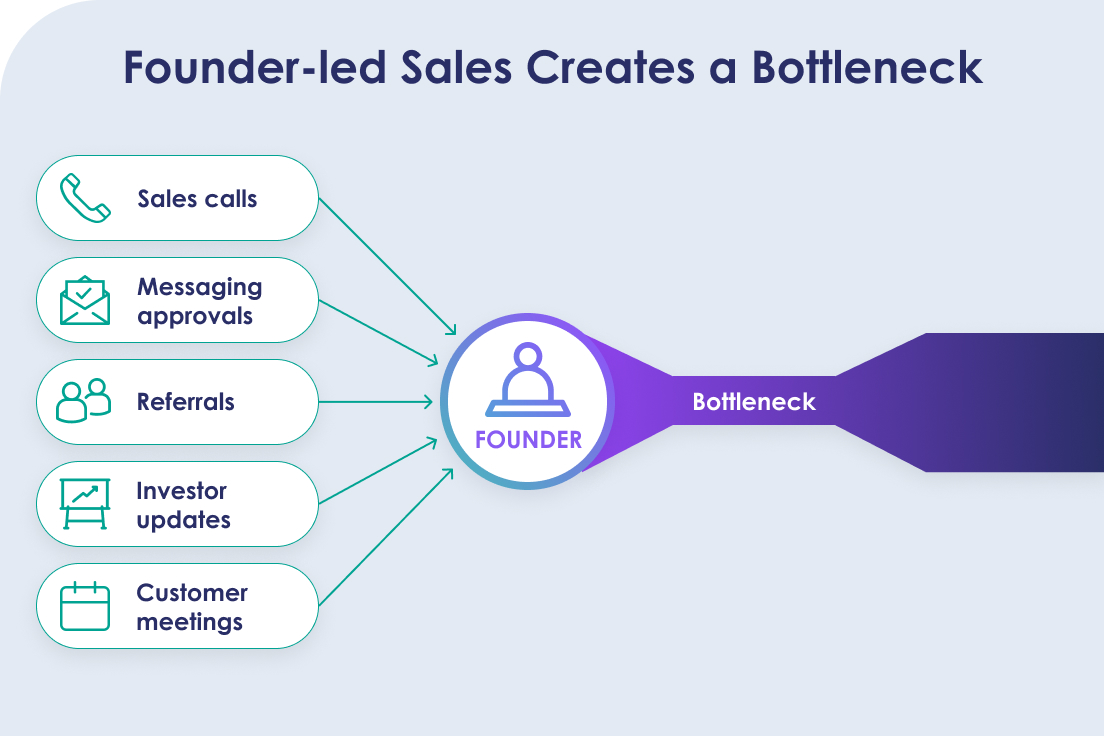
Founder-led selling has a hard ceiling. As deal volume grows, the CEO gets pulled into more and more prospect engagements. Opportunities stall or go to competitors, and growth flattens despite a real market opportunity.
The bottleneck is not the product or the market, but rather the model. Personal networks and founder energy can launch a company, but they cannot scale one.
Some founders, especially those coming from broader tech backgrounds, apply a “fail fast, learn faster” mindset to go-to-market. In life sciences tech, that is an expensive way to operate and does not establish a scalable GTM strategy.
Selling complex SaaS or analytics solutions into pharma and biotech means long sales cycles, multi-stakeholder buying committees, and high switching costs. Missteps are not cheap.
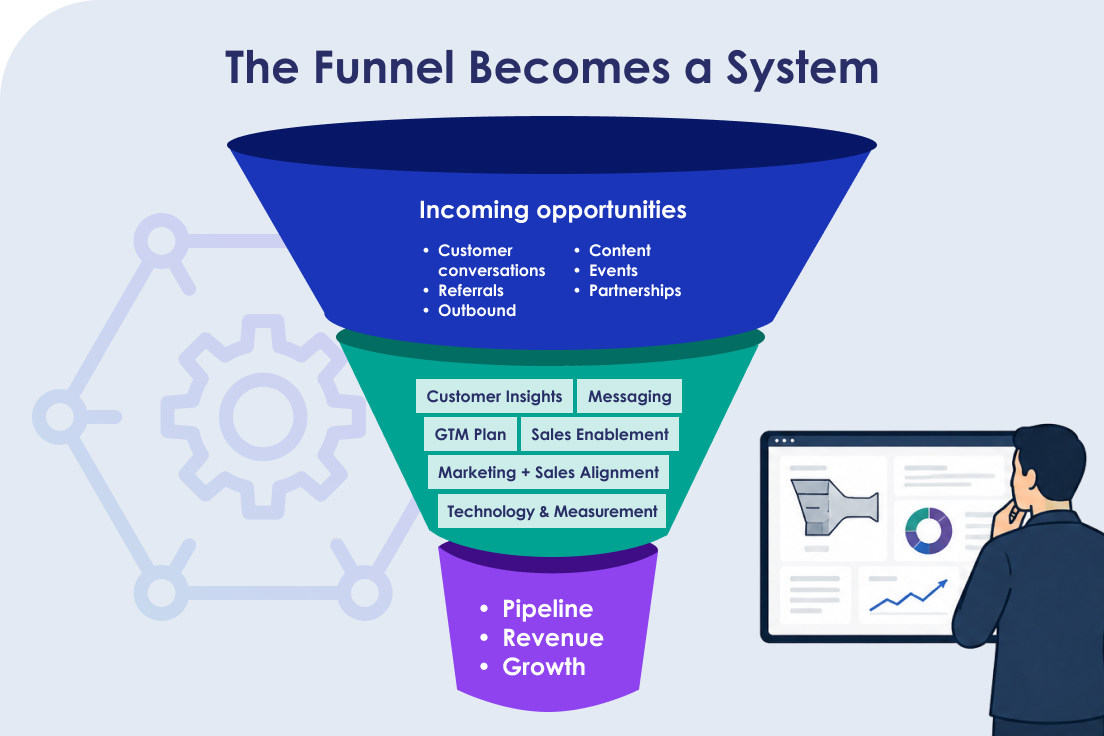
Successful companies build infrastructure that allows growth to continue even when the founder steps away from day-to-day selling.
Key components include:
Before building campaigns or assets, invest time in direct customer conversations. Understand what problems are urgent, who feels the pain, and what the business impact is.
When selling into larger companies, a single deal might involve data science, IT, market access, and commercial operations teams, each evaluating your solution from a different angle. That kind of discovery converts generic pitch decks into messaging that actually moves deals forward.
Your value proposition has to work across both technical and business buyers. Too technical and you lose the executive sponsor. Too generic and you lose credibility with the CTO.
Build a messaging framework anchored in outcomes: faster trial timelines, better data quality, sharper commercial decisions. That framework should hold together from your website to your sales deck to how your reps talk on calls.
Marketing, sales, and product need to be aligned on the same targets, the same priorities, and the same definition of success. That means clear roles, a budget allocated to real growth levers, and KPIs reviewed regularly with commercial leaders.
The best founders eventually transfer their knowledge to others.
Sales playbooks, objection handling guides, customer stories, and qualification frameworks help new team members replicate successful conversations and create consistency across the organization.
Many startups invest in marketing before aligning on goals, customer profiles, and measurement.
The strongest go-to-market teams share accountability for pipeline creation and revenue outcomes. Marketing, sales, and product teams work from the same priorities and metrics.
Scalable growth requires visibility.
CRM systems, reporting dashboards, attribution models, and KPI scorecards help leadership understand what is working and where investments should be made next.
This phase often represents the transition from founder-led sales to a true commercial organization.
Cross-functional alignment matters just as much. Customer insights should flow back to product. Marketing should be building tools that match where buyers are in their evaluation. Everyone on the commercial team should be telling the same story about who you help and how.
A scalable GTM framework defines how the commercial engine runs when the founder is not in every conversation.
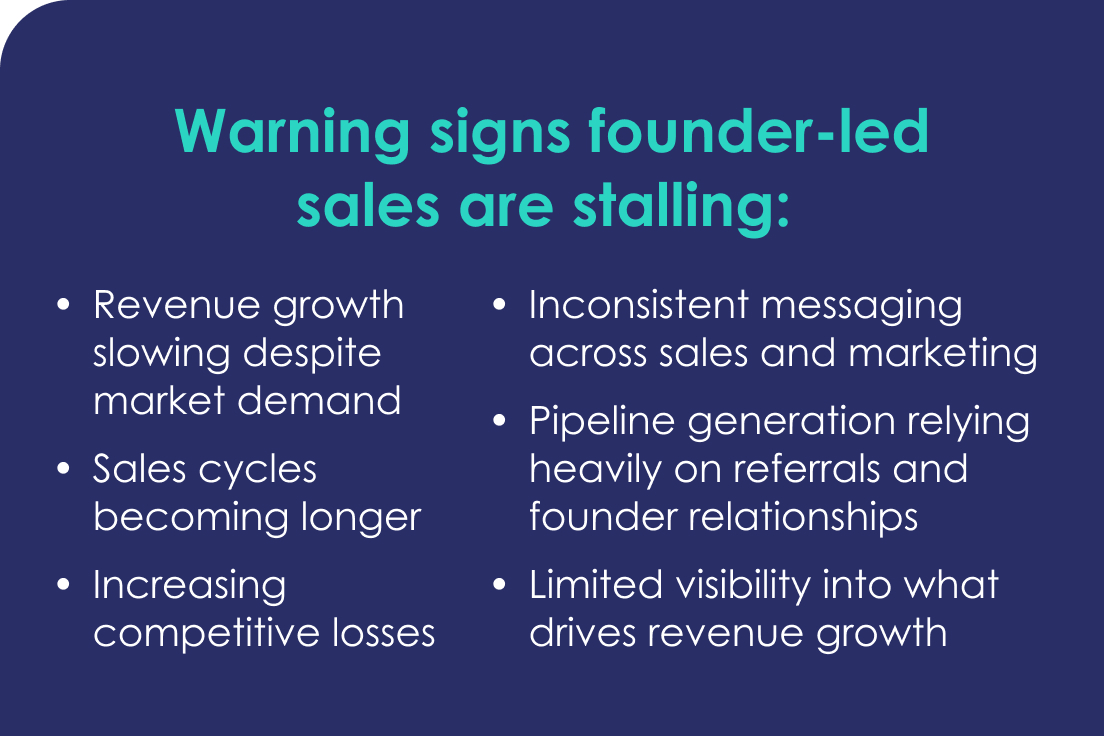
Most founders sense they need help before they are ready to act on it. The clearest signals are straightforward: revenue growth is stalling despite market opportunity, or the CEO is spending more time on deals than on running the company.
At that point, external marketing leadership, whether a fractional CMO, an embedded strategist, or a specialized agency, can accelerate the transition. The right partner does more than run campaigns. They help define the commercial model, build messaging infrastructure, and put systems in place that hold up as the company scales.
This is especially true for startups in the in-between stage: past early traction, but not yet large enough for a full senior marketing team. An external partner can close that gap and reduce the risk of building the wrong foundation.
A few mistakes show up repeatedly in life sciences tech startups:
Skipping strategy to go straight to tactics. Launching campaigns before messaging is defined burns budget fast. Get the foundation right first.
Treating the Rolodex as a growth engine. Personal networks close early deals, but they do not build repeatable pipeline at scale.
Treating the commercial transition as just a sales hire. Bringing in a sales team without the right messaging, tools, and marketing support sets everyone up to fail.
Waiting too long to make the shift. The longer a company delays building a repeatable commercial model, the harder the transition becomes.
For companies selling into healthcare, life sciences, and other regulated markets, this transition is one of the most important milestones on the path to scale. The challenge is building the right structure at the right time without slowing momentum or making costly hiring decisions too early.
That is where Rebound Marketing can help.
Through Marketing Acceleration™, Rebound works as an outsourced marketing partner for companies selling into life sciences, health tech, and regulated markets. We combine strategic leadership, execution, and an adaptive team model to help founders move from founder-led growth to a scalable go-to-market system that evolves as the business grows.
Contact Rebound to learn how Marketing Acceleration™ helps life sciences and health tech companies establish traction faster and build a stronger foundation for long-term growth.

A: The clearest signals are slowing revenue growth despite real market opportunity, longer sales cycles, and a CEO whose calendar is dominated by prospect engagements. When closing business is consuming too much of the founder’s bandwidth, it is time to build a commercial model.
A: It includes a defined ICP, a differentiated messaging framework, sales enablement tools, a CRM with accurate pipeline visibility, and marketing programs that generate demand independent of the founder’s network. All of this needs to be aligned across marketing, sales, and product.
A. Not necessarily, especially in early growth stages. Many companies benefit from a fractional CMO or embedded marketing partner who can build strategy and infrastructure without the cost of a full-time hire. The right answer depends on stage, budget, and how fast you need to move.
A: Sales cycles are longer, buying committees are larger, and regulatory context shapes how buyers evaluate risk. Messaging needs to work across technical and business stakeholders in functions like data science, IT, clinical, and commercial operations. Generic B2B playbooks underperform in this environment.

To make sure you get accurate and helpful information, this guide has been edited and fact-checked by the Rebound Editorial Team.