
Most healthtech companies hit the same wall eventually. Early growth comes from hustle, and founder relationships often drive the first deals. Sales happen through persistence, referrals, and product credibility, so the marketing is reactive but manageable. Everyone is close enough to the customer that the system gaps are easy to work around.
Then the company grows.
New funding brings bigger targets, so the sales team expands. The marketing team launches more campaigns. Suddenly, the go-to-market motion that once felt agile starts creating friction instead of momentum.
Marketing and sales drift out of alignment. Messaging changes depending on who is talking. Pipeline volume increases without improving conversion quality. Leadership pushes for faster growth while the team struggles to operationalize what used to happen naturally.
Most health tech GTM strategies fail at this stage because the company scales activity before it builds the structure required to support growth.
What worked during early traction starts breaking under pressure, creating wasted spend, operational chaos, and a go-to-market system that cannot scale with the business.
Most early-stage health tech companies grow through founder persistence.
The founder knows the product better than anyone else. Early customers come through referrals, networking, and direct credibility with buyers.
That works for a while, but as the company raises funding and revenue targets increase, investors will want predictable pipeline growth. The founder suddenly becomes the bottleneck.
Most health tech companies underestimate how quickly this transition happens.
What worked during early traction often creates problems during scale:
In healthcare and life sciences markets, those weaknesses compound quickly because sales cycles are already long, and buying committees are already complex.
You cannot scale revenue consistently if every deal depends on founder intervention.
Many founders come into growth conversations saying the same thing: “I need leads.” But lead volume is not the real issue if the underlying go-to-market structure is weak. This is where many health tech GTM strategies start breaking down.
The company raises funding and immediately shifts into execution mode, by launching more campaigns and outreach, hoping this will lead to more lead generation.
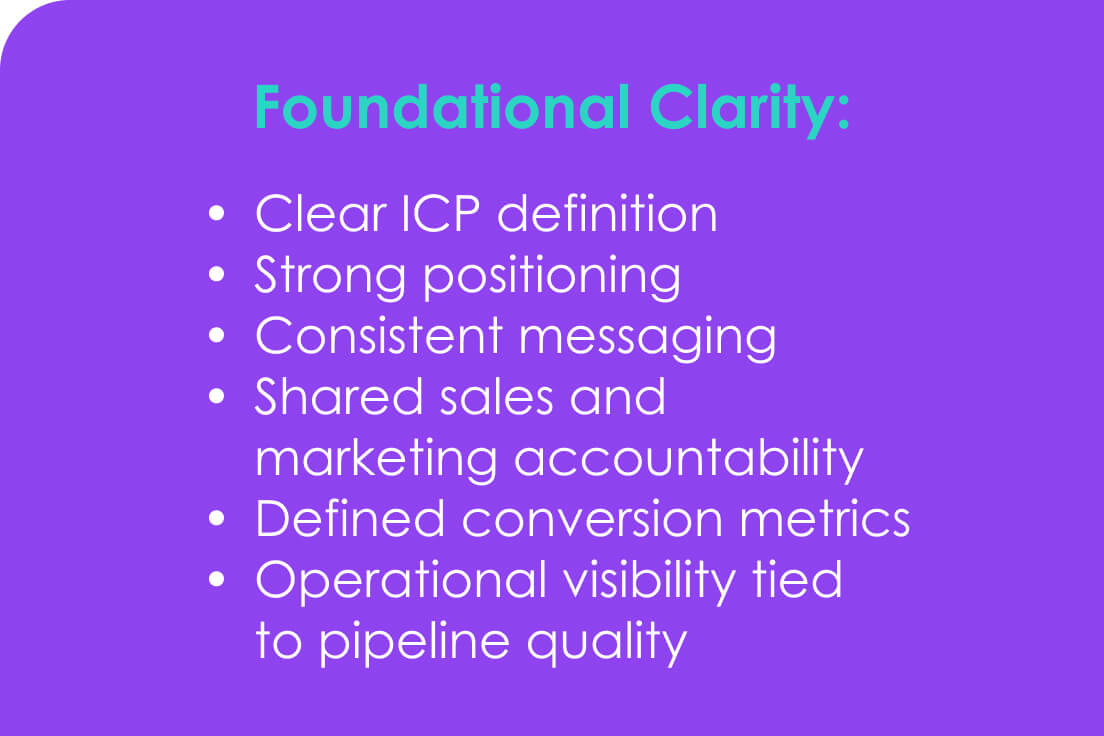
The problem is that foundational GTM systems are often missing underneath all that activity.
The real questions to ask are:
If those answers are unclear, scaling activity only creates more waste.
The default answer to growth pressure is usually hiring. When businesses reach a period of growth, they will quickly hire leadership, such as a VP of Marketing and a CMO and expect them to build an internal team.
That feels logical, but the math often works against the company.
Given the current average salaries, recruiting fees, and onboarding processes, it can cost over $800,000 in just the first year alone to bring on a full-time CMO. Factoring in that most new hires take six to nine months before they reach full productivity, existing teams absorb training overhead during that period, and operating complexity increases before results improve.
That timeline becomes risky for companies operating under investor pressure.
Modern B2B marketing requires multiple specialized capabilities:
One senior hire cannot realistically cover all of those functions.
Healthcare and life sciences markets add another layer of complexity because domain fluency matters. Teams need to understand regulated buying environments, technical audiences, compliance concerns, and credibility dynamics from the start.
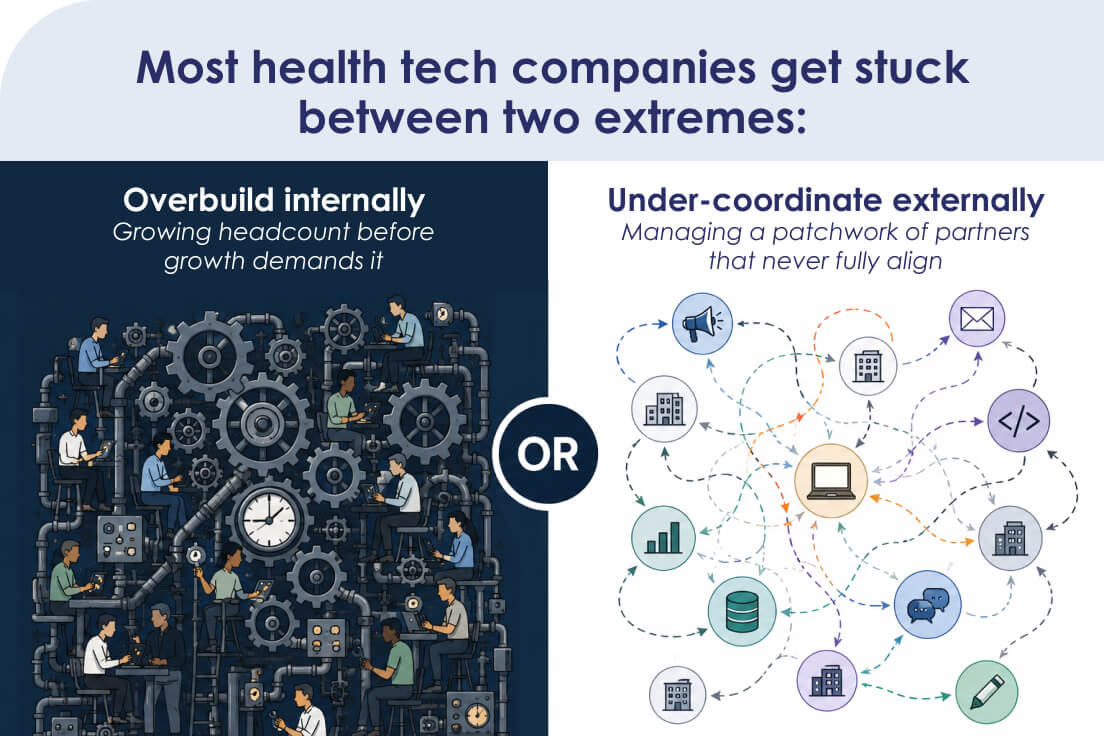
This is why many health tech companies end up stuck between two bad options:
Neither model scales well.
AI is changing how fast companies can build products, enter markets, and create visibility. Some AI-driven companies are reaching significant revenue milestones in extremely short timeframes.
That speed creates new pressure on every growth-stage company trying to establish market position. The result is that weak GTM systems break faster than they used to.
AI can accelerate execution, but it cannot fix unclear positioning or inconsistent messaging. In fact, it often amplifies those problems.
Many healthcare SaaS vendors rushed into AI-generated content over the last two years. Most of that content failed because the foundational GTM strategy underneath it was weak.
Content that is not grounded in real buyer pain points and market realities becomes noise. Google is already filtering out massive amounts of low-quality AI-generated content that lacks expertise and credibility signals.
The companies seeing real results with AI are not replacing strategy with automation.
They are using AI to increase speed inside structured operating systems.
Scalable GTM systems focus on repeatability before acceleration.
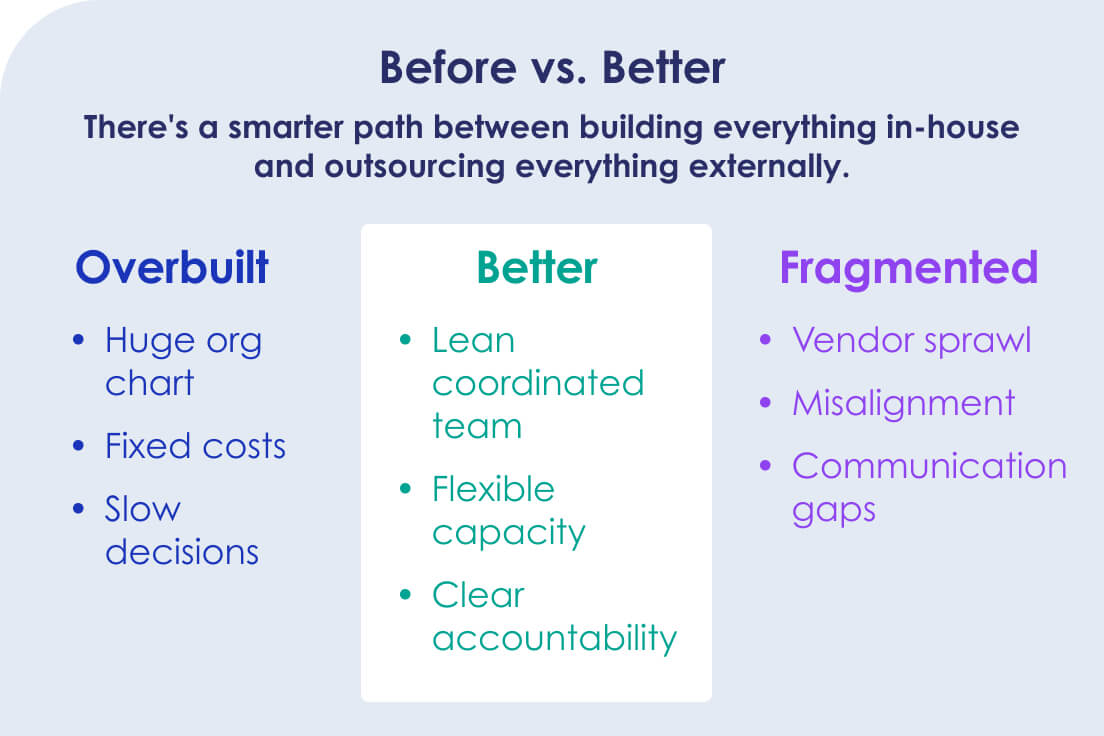
But for many companies, the answer is not a full in-house marketing team yet and instead finding the right marketing capability at the right time.
That may mean a fractional CMO to set strategy, align sales and marketing, and build the roadmap before the company commits to a senior full-time hire. Or it may mean a fractional marketing team that can support specific projects, goals, and timelines without locking the business into fixed headcount too early.
This is where Rebound Marketing helps health tech and life sciences vendors build a stronger path to scale. We bring the strategy, execution, and market fluency needed to clarify ICP, sharpen positioning, improve messaging, support pipeline growth, and create a GTM structure that evolves with the business.
If your company is scaling beyond founder-led growth, now is the time to evaluate whether your GTM structure can support the next stage of revenue growth. Reach out to Rebound Marketing today.

Why do most health tech GTM strategies fail to scale?
Most fail because companies increase marketing and sales activity before building repeatable systems for positioning, pipeline generation, and operational alignment.
Why is founder-led sales hard to scale?
Founder-led sales rely heavily on individual relationships and product knowledge. That creates bottlenecks as pipeline volume and organizational complexity increase.
Should healthcare SaaS companies hire a CMO early?
Not always. Many growth-stage companies need flexible execution depth and integrated GTM capabilities before committing to large fixed-cost internal teams.
What does scalable GTM look like for companies selling into healthcare?
Scalable GTM systems combine strong positioning, repeatable pipeline generation, aligned sales and marketing operations, and adaptive team structures built for regulated healthcare markets.

To make sure you get accurate and helpful information, this guide has been edited and fact-checked by the Rebound Editorial Team.