

For many healthcare tech founders, there comes a point when the marketing model that got the company started stops being enough.
Early customers came through relationships, founder persistence, and product credibility. But investors want pipeline and the founder cannot stay at the center of every customer conversation and marketing decision forever.
The obvious next move is often: hire a CMO.
But a full-time CMO isn’t automatically the right answer. For many startups, the better question is whether you need permanent headcount or CMO-level leadership paired with the execution capacity to turn strategy into traction.
A fractional CMO for healthcare tech provides senior marketing leadership – ICP definition, positioning, go-to-market strategy, channel prioritization, and sales alignment – without requiring a permanent C-suite hire.
That can mean defining the ICP, sharpening positioning, establishing go-to-market priorities, aligning marketing and sales, and determining where marketing resources should go next.
For startups, however, there is an important catch: leadership alone does not provide execution.
A fractional CMO can build the strategy. Someone still has to execute the content, demand generation, digital marketing, product marketing, sales enablement, and marketing operations behind it. In healthcare tech specifically – where buying cycles are long, buyers are sophisticated, and compliance considerations shape how you can market – the gap between a strategy and market activity is significant.
A full-time CMO gives you dedicated executive leadership and long-term organizational ownership. But that executive is only one piece of the marketing organization.
The average annual salary for a CMO is over $374,000, not including recruiting costs or the execution team they’ll need. It also takes around six to nine months before a new CMO is producing at full capacity – runway most early-stage healthcare tech startups can’t afford to spend.
There is also the consideration of the person’s specialty, experience, and skills. One hire gives you one profile and leaves many other capabilities to be filled.
A fractional CMO for startups changes the equation by giving the company access to senior leadership without immediately committing to that permanent structure.
But a strategy-only fractional CMO can leave another organizational problem behind: Who does the work?
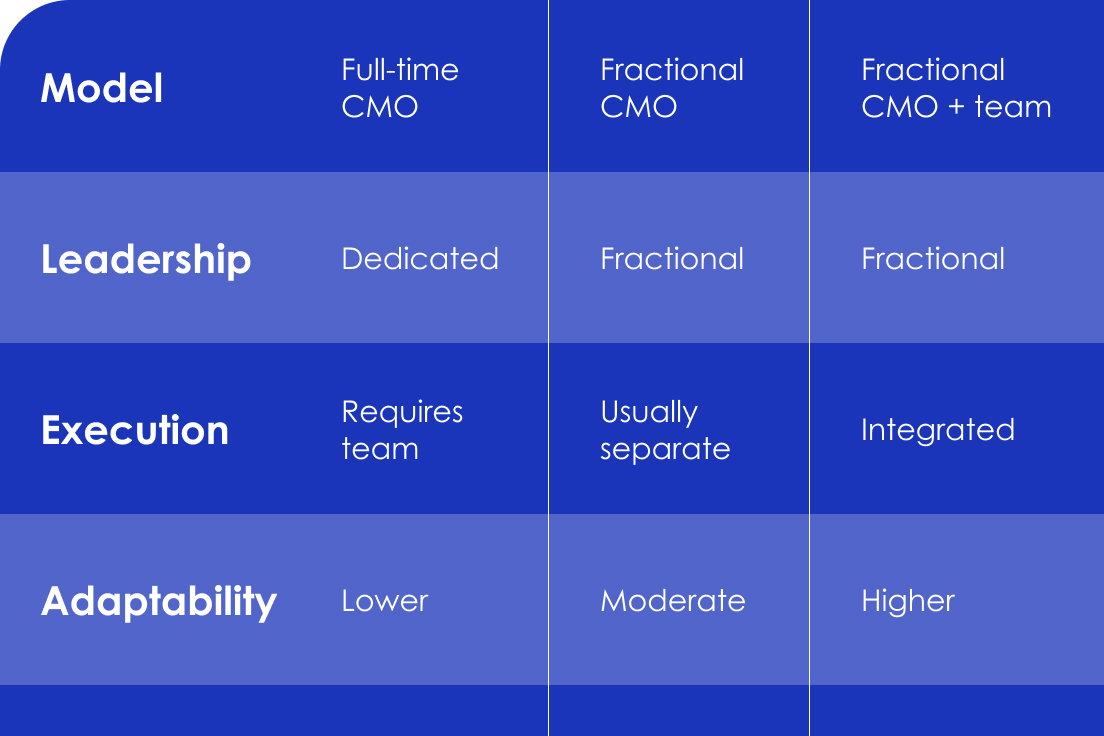
That’s why founders should really evaluate three options:
The right choice depends less on the title you think you need and more on the capabilities your business needs now.
For healthcare tech startups, a fractional model is typically stronger than a full-time hire when speed, breadth, and flexibility matter more than permanent organizational ownership.
Hiring and ramping a senior executive takes time. For a company facing investor expectations, pipeline pressure, or another funding milestone, that delay can consume valuable runway.
A leadership gap often signals a broader organizational gap. If you simultaneously need positioning, content, demand generation, digital, sales enablement, and marketing operations, one senior hire won’t provide all of that execution.
Marketing requirements change as startups mature. A flexible model can adapt to those requirements instead of locking the company into a team designed for an earlier stage.
Healthcare tech companies often sell into sophisticated and regulated buying environments, including pharma, biotech, providers, and payers. Market fluency, credibility, compliance considerations, and buyer expectations create requirements that generalist B2B marketers may need time to learn.
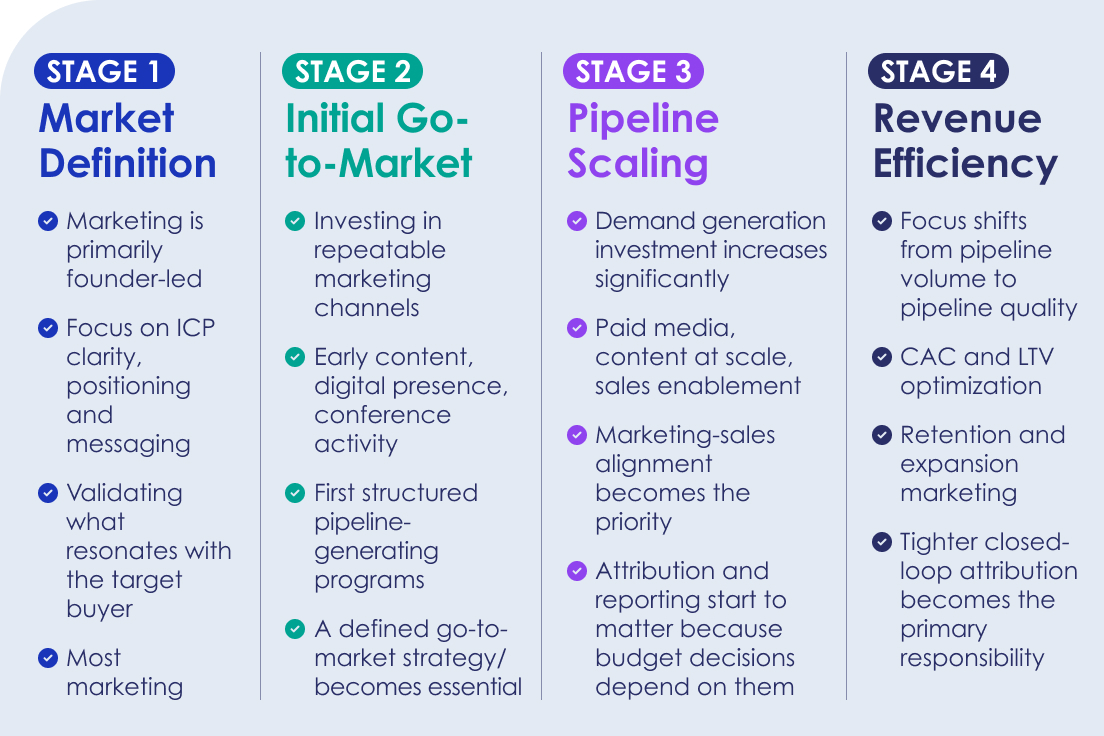
Marketing requirements in healthcare tech don’t stay static. As companies grow, the mix of priorities, capabilities, and resources the marketing function needs changes significantly. Understanding which stage your company is in clarifies what kind of marketing leadership you actually need.
A fractional model is often most valuable at the transition between stages – when the company needs new capabilities quickly and hasn’t yet built the internal team to support a full-time executive.
A full-time CMO is the right answer when the company needs permanent executive ownership, has sufficient stable scope to justify the role, and already has – or is ready to build – the execution organization behind that leader.
The goal is to build the right structure at the right stage and avoid committing too early to an organization that may not match what the business needs next.
The fractional conversation often focuses too narrowly on the employment model. Founders should evaluate fractional vs. full-time alongside another important decision: strategy only vs. strategy plus execution.
A founder needs more than another strategy deck sitting in a folder. They need someone accountable for turning the strategy into market activity and business outcomes.
That’s the case for a fractional marketing team for startups: CMO-level direction paired with specialists who can actually deliver the work.
Rebound’s model combines fractional CMO leadership with execution across brand, content, digital, product, and marketing operations. The team that helps develop the plan is accountable for delivering it, reducing the handoff between strategy and execution.
For a healthcare tech startup, choosing between fractional and full-time should start with your growth stage rather than an org chart.
If marketing still depends heavily on the founder, you need multiple specialist capabilities, and priorities are changing quickly, fractional leadership paired with an integrated execution team may make more sense than building internally today.
If you already have a strong execution team and only lack senior direction, a strategy-focused fractional CMO may be enough.
Rebound’s Marketing Acceleration™ model is designed for healthcare tech companies that need to move fast without building a full internal marketing organization first. A fractional model can give a growing company the structure it needs today while preserving the flexibility to build its internal marketing organization when the timing is right.
Ready to figure out which model fits? Book a strategy call with Rebound to map your current stage and determine the right marketing structure for what comes next.

Q: Is a fractional CMO worth it for a healthcare tech startup?
A: It can be – particularly when a startup needs senior marketing leadership but isn’t ready to build a complete internal marketing organization. The model delivers more value when execution capabilities accompany the leadership, so strategy translates into actual market activity.
Q: When should a startup hire a fractional CMO?
A: Common triggers include founder-led growth becoming a bottleneck, increasing pipeline pressure from investors, a recent funding event, and needing multiple marketing capabilities without committing to permanent headcount.
Q: What’s the difference between a fractional CMO and a fractional marketing team?
A: A fractional CMO primarily provides senior leadership – strategy, positioning, and prioritization. A fractional marketing team adds the specialists required to execute that strategy. Some models, like Rebound’s Marketing Acceleration™, combine both under one accountable engagement.
Q: How much does a fractional CMO cost compared to a full-time hire?
A: A full-time CMO typically costs over $374,000 annually in salary alone, plus recruiting and ramp time of six to nine months. A fractional CMO arrangement is structured by scope and hours, making it a faster and more flexible way to access CMO-level expertise without the full organizational commitment.
Q: When should you hire a full-time CMO instead?
A: Full-time becomes more compelling when the company needs permanent executive ownership, has stable and sufficient marketing scope to justify the role, and can support the execution organization behind the CMO.

To make sure you get accurate and helpful information, this guide has been edited and fact-checked by the Rebound Editorial Team.