

Your marketing dashboard says things are moving in the right direction. Traffic is growing, campaigns are generating responses, and new leads are entering the funnel. Then you look at pipeline, and the same momentum is nowhere to be found.
For health tech founders and marketing leaders, that disconnect can quickly turn into a lead generation conversation. Teams begin evaluating new campaigns, more content, paid media, events, or other ways to bring more prospects into the funnel.
But before increasing spend, it is worth looking more closely at what happens to demand after marketing creates it.
When sales and marketing have different definitions of the ideal customer, qualification, buyer intent, or core value proposition, promising leads can lose momentum as they move through the funnel. Marketing may be generating the results it was asked to produce while sales simultaneously struggles to turn those results into qualified opportunities.
That is what makes misalignment difficult to diagnose: both teams can appear to be doing their jobs while pipeline still falls short.
For health tech startups, stronger sales and marketing alignment helps close these gaps and creates a better foundation for the broader go-to-market strategy.
Misalignment often becomes apparent when you compare marketing performance with downstream sales results.
Marketing may be hitting targets for traffic, engagement, conversions, and MQLs. Meanwhile, sales may find that many of those leads lack the right fit, urgency, authority, or business need to justify a serious conversation.
Both perspectives can be valid.
The disconnect often starts earlier in the go-to-market process. If sales and marketing have not aligned around the ICP, buying roles, qualification criteria, and core messaging, each team can execute well against a different understanding of the market.
Marketing optimizes campaigns based on one definition of a good prospect. Sales evaluates those prospects against another. Over time, the gap becomes visible in familiar ways: sales questions lead quality, marketing struggles to demonstrate pipeline impact, and leadership lacks a clear view of what needs to change.
Health tech adds another layer of complexity because purchasing decisions frequently involve multiple stakeholders. Gartner reports that the average enterprise B2B buying group includes five to 11 stakeholders across an average of five business functions.
Each stakeholder may enter the buying process with different priorities and questions. A clinical stakeholder may focus on outcomes and workflow, while other stakeholders may be evaluating the business case, security requirements, implementation considerations, or organizational risk.
That makes consistency throughout the buying experience especially important. According to Gartner’s B2B Buying Report, buyers are 2.8 times more likely to complete a high-quality deal when they perceive high information consistency between a supplier’s website and its sales representatives.
For health tech companies, alignment therefore goes beyond agreeing on who owns which stage of the funnel. Marketing and sales need a shared understanding of the buyer, the problem the company solves, and the value it delivers so prospects encounter a coherent story throughout the buying process.
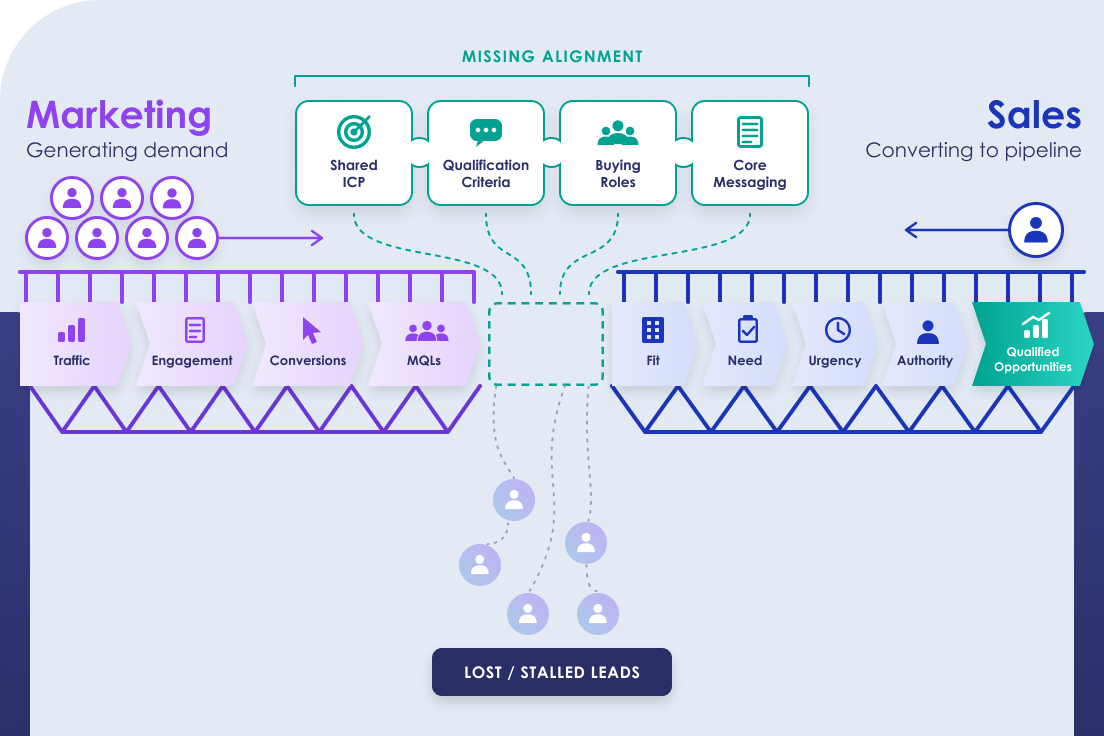
Complex buying groups can make gaps between sales and marketing more consequential.
Health tech companies may need to engage clinical champions alongside operational, financial, technical, security, compliance, procurement, or executive stakeholders. Not every stakeholder enters the conversation at the same time or evaluates the solution through the same lens.
The path from initial interest to a larger commercial relationship can also involve several stages. For some companies, a pilot or initial deployment is one step toward broader adoption rather than the end of the sales process.
These dynamics make it important for marketing and sales to understand not only the primary buyer, but also the other stakeholders who can influence progress.
Marketing can support that process by creating content and messaging that addresses the questions different stakeholders bring to the decision. Sales, in turn, can provide marketing with direct feedback about which objections arise, which messages resonate, and where opportunities tend to slow down.
Without that feedback loop, the two teams can gradually tell different versions of the same story.
Pipeline problems can have many causes, but these four patterns can help health tech leaders identify when alignment deserves closer attention.
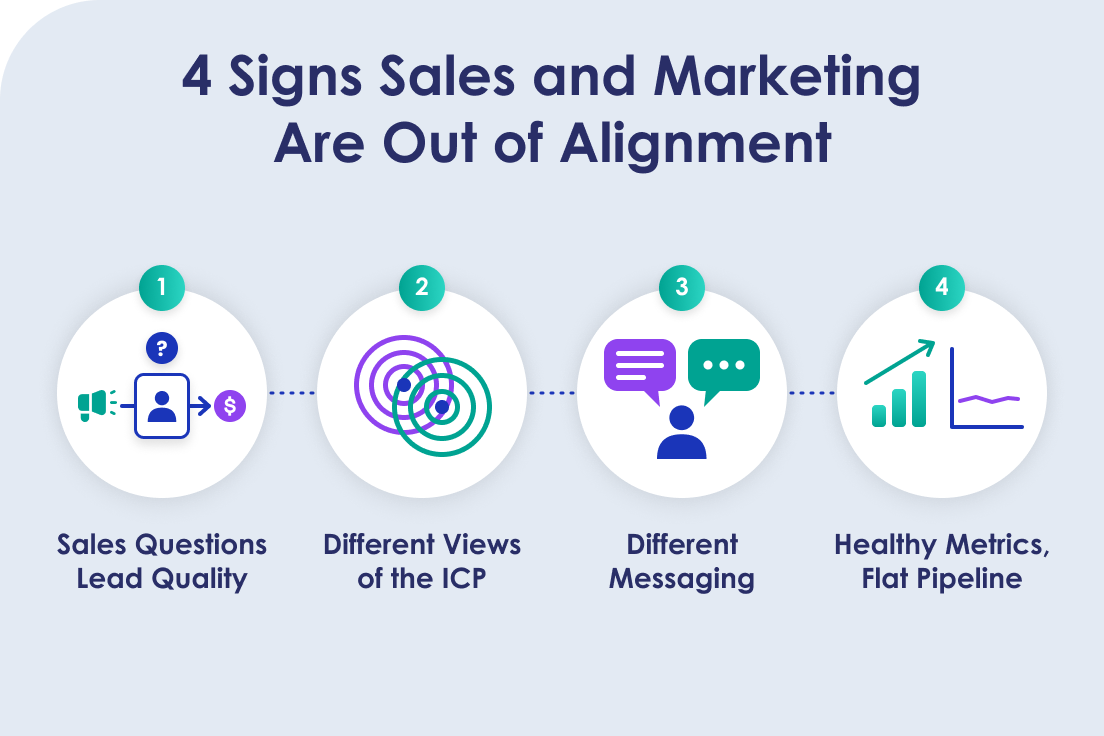
If sales repeatedly reports that marketing leads are unqualified, look first at how both teams define qualification.
Marketing may evaluate prospects based on signals of fit, such as company characteristics, job title, content engagement, or a form submission. Sales may place greater weight on readiness signals such as urgency, organizational need, buying authority, or a clearly defined business problem.
Neither perspective is inherently wrong. The problem arises when the criteria are never reconciled.
Without shared definitions, marketing can hit its lead targets while sales receives prospects that do not meet its expectations for a sales-ready opportunity.
Both teams should agree on what makes an account a good fit, which behaviors indicate meaningful intent, and what needs to be true before a prospect moves into active sales engagement.
For early-stage companies, this work is especially valuable before campaigns begin to scale. A focused 90-day GTM roadmap can connect ICP validation, messaging, campaign priorities, and lead qualification so sales and marketing are working toward the same pipeline goals.
Here is a simple test: ask sales and marketing to describe the ideal customer separately, then compare their answers.
Differences may appear around company size, organization type, buyer role, pain points, maturity, use cases, or buying triggers. Even relatively minor differences can influence campaign targeting, content strategy, sales outreach, and qualification.
Rather than resolving those differences based on which team has the stronger opinion, look at customer and pipeline evidence.
Review the characteristics of won, lost, stalled, and disqualified opportunities. Which organizations progress? Which buyer roles engage? Where do opportunities tend to stall? Are there segments that repeatedly generate interest but rarely move forward?
That information gives both teams a stronger foundation for defining and refining the ICP around actual market feedback.
The goal is not to write an ICP once and treat it as permanent. It is to create a shared definition that both teams use and continue improving as the company learns more about its market.
Sales conversations generate valuable information about which problems create urgency, which objections repeatedly surface, and which value propositions resonate with buyers.
When those insights remain within the sales team, marketing may continue building campaigns around assumptions that no longer reflect what buyers are saying.
The result can be a fragmented buying experience. A prospect encounters one value proposition on the website, another in campaign content, and a third during a sales conversation.
Gartner also reported in its 2025 B2B Buyer Survey that 69% of surveyed B2B buyers had encountered inconsistencies between information on a sales organization’s website and information provided by sellers. The research found that these inconsistencies can create mistrust and put transactions at risk.
For health tech companies with multiple stakeholders involved in the decision, consistency becomes even more important. The message may need to adapt to a clinician, operations leader, technical stakeholder, or financial decisionmaker, but the underlying positioning should remain recognizable.
Regular communication between sales and marketing helps keep website copy, campaigns, content, sales materials, and conversations grounded in the same strategic narrative.
Growing traffic, engagement, downloads, and MQL volume can indicate that marketing is creating interest. They do not, by themselves, show how effectively that interest is becoming pipeline.
To understand the difference, look further downstream:
This becomes especially important with channels such as events, where visible activity can easily be mistaken for pipeline impact.
A stronger approach to life sciences tech event marketing connects audience targeting, lead capture, sales follow-up, and post-event nurture while measuring performance through MQLs, SQLs, opportunity creation, and pipeline influence.
The same principle should apply across the marketing program. Connecting channel performance to downstream sales outcomes gives leadership a clearer view of which activities contribute to pipeline and where sales and marketing coordination may need improvement.
Improving alignment starts with shared definitions and consistent feedback around the areas that directly influence pipeline.
Sales and marketing should work from the same definition of the organizations and stakeholders the company is best positioned to serve.
Use evidence from customers, active opportunities, lost deals, disqualified leads, and buyer conversations to build that definition. Then revisit it as the company gathers more market evidence.
Establish clear criteria for fit, intent, marketing qualification, sales readiness, and opportunity creation.
Both teams should understand what needs to be true before a lead progresses and what happens when sales determines that a lead is not ready.
That last part matters. A rejected lead should create information marketing can use, not simply disappear from the process.
Marketing and sales should work from the same understanding of customer problems, differentiation, value, and proof.
The expression of that message can change by stakeholder, channel, and funnel stage. A clinical audience does not necessarily need the same information as a financial or technical stakeholder.
But those variations should all reinforce the same core positioning rather than introducing competing explanations of what the company does and why it matters.
Sales should regularly bring objections, buyer priorities, recurring questions, and lost-deal insights back to marketing.
Marketing can use that information to refine targeting, campaigns, content, messaging, and qualification criteria. It can then share what changed and what the resulting performance data shows.
This turns alignment into an ongoing operating practice rather than a one-time messaging or planning exercise.
It also gives marketing a better basis for deciding what to scale. Instead of evaluating campaigns solely through engagement and lead volume, the team can incorporate sales feedback and opportunity progression into its investment decisions.
Generating more demand can absolutely be part of solving a pipeline gap. The question is whether the current go-to-market system is positioned to turn that additional demand into qualified opportunities.
Before increasing spend, compare how sales and marketing define the ICP, evaluate leads, communicate value, and share market feedback.
Then look at the pipeline together.
Where do high-quality opportunities originate? Where do prospects tend to stall? Why does sales accept some leads and reject others? Which messages, channels, and segments are associated with stronger opportunity creation?
Answering those questions can help leadership distinguish a true demand problem from gaps elsewhere in the go-to-market process.
For health tech startups, stronger alignment also creates a clearer view of marketing performance. Leadership can evaluate marketing based on its contribution to qualified opportunities and pipeline, while marketing gets better information about which audiences, messages, and investments deserve greater attention.
More demand is valuable when the system behind it is prepared to convert it.
If your health tech company is generating marketing activity without enough qualified pipeline, contact Rebound to assess your go-to-market strategy and identify opportunities to strengthen ICP definition, qualification, messaging, demand generation, and sales alignment.

What is sales and marketing alignment in health tech?
Sales and marketing alignment in health tech means both teams share a consistent understanding of the ideal customer, buyer needs, qualification criteria, messaging, and pipeline goals. Because health tech buying decisions can involve multiple stakeholders, alignment also helps ensure those audiences receive a consistent strategic narrative throughout the buying process.
What causes pipeline gaps in health tech?
Pipeline gaps can have several causes, including insufficient demand, targeting problems, unclear qualification criteria, inconsistent messaging, or friction as prospects move through the funnel. When marketing activity is healthy but qualified opportunities remain limited, differences between how sales and marketing define and evaluate prospects are worth examining.
How does sales and marketing misalignment affect lead quality?
Misalignment can cause marketing and sales to evaluate prospects using different criteria. Marketing may identify a lead as qualified based on fit and engagement, while sales may require additional evidence of urgency, authority, organizational readiness, or a defined business need. Shared qualification criteria help both teams evaluate leads more consistently.

To make sure you get accurate and helpful information, this guide has been edited and fact-checked by the Rebound Editorial Team.