
Early revenue in healthcare SaaS almost always runs through founder relationships, domain expertise, and market knowledge that takes years to develop. Those advantages create traction, but not a repeatable commercial engine.
The ceiling is almost always about distribution. At some point, the commercial model that validated the business stops generating the volume or predictability the next stage requires, and the team usually feels it before the metrics confirm it.
The GTM model that works at $2M ARR rarely survives to $15M unchanged. Companies that recognize those transition points early scale with more control and less disruption to the commercial momentum they’ve built.
Growth doesn’t happen because marketing spends more or sales hires more people, but because the commercial model matures.
Every healthcare SaaS company reaches a point where the systems that supported early growth need to evolve. The organizations that recognize these transitions early are better positioned to scale without losing momentum.
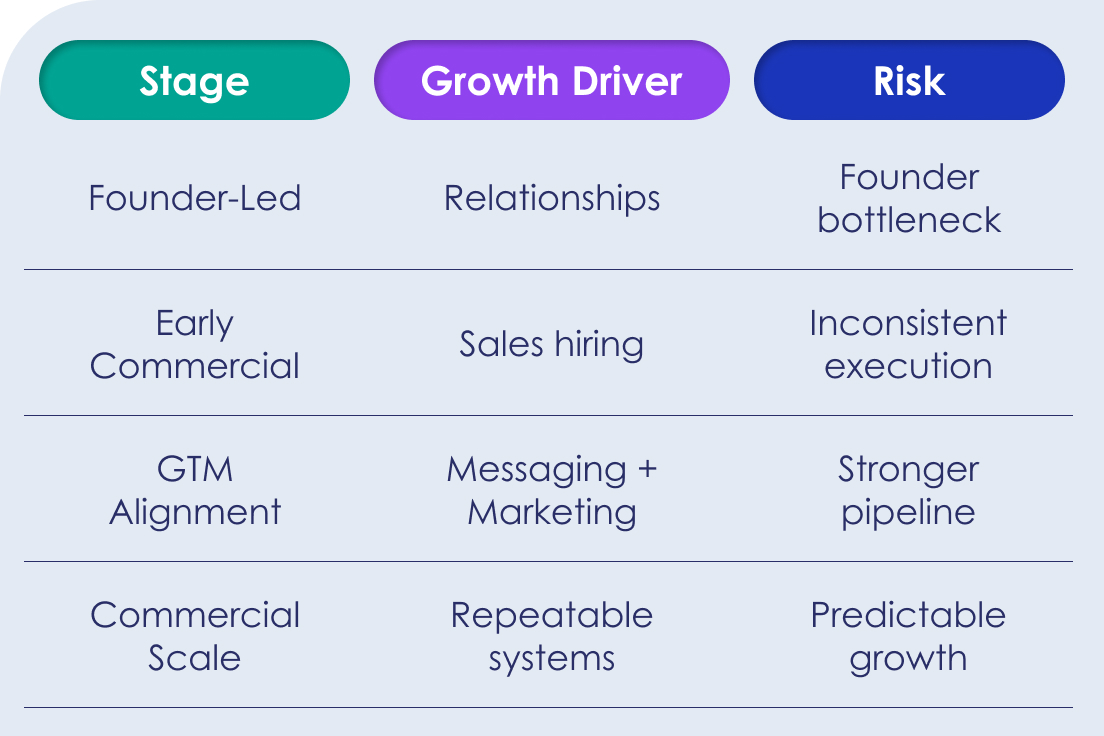
The transition that changes the trajectory is GTM Alignment. This is where the commercial model stops depending on individual heroics and starts depending on infrastructure. It’s also where most of the leverage is.
These four stages form the foundation of how Rebound’s Marketing Acceleration™ framework is structured, built around the insight that strategy and execution have to evolve together, and that each stage requires different inputs.
In the earliest stages, founders accumulate deep knowledge through customer conversations: pain points, buying triggers, objections, and the specific language buyers use to describe their problems. That knowledge closes early deals but doesn’t scale.
Scaling requires converting those conversations into something the whole organization can use:
For healthcare SaaS companies, this step matters more than in most B2B environments. A single deal can involve clinical leaders, IT, procurement, compliance, finance, and an executive sponsor, each evaluating risk differently, and each needing a message built for their specific priorities.
When that knowledge lives in the founder’s head, every new commercial hire starts from scratch. When it’s documented, they start from a foundation.
Most companies recognize the Founder-Led stage well.
The Early Commercial stage is where many companies get stuck. A sales team exists, but execution is inconsistent, and the gap usually comes down to whether the company’s story is shared across the team or improvised by each rep.
Early customers buy on founder trust. Later ones have to trust the company, which requires a different kind of commercial foundation.
That shift requires a messaging framework that anyone on the commercial team can use with confidence. When it exists, marketing reinforces the same narrative sales uses in conversations. Product teams understand which capabilities buyers value most. New hires ramp faster because they’renot rebuilding the company’s story from memory.
The clearest sign this work is done: someone other than the original deal-closers can explain what the company does and why it wins, with the same credibility as the people who have been doing it for years.
Referrals and industry relationships close early deals. They rarely produce the consistent, attributable volume a growth-stage company needs to hit its targets.
This is where demand and digital marketing becomes a core part of the commercial model rather than a supporting function. Healthcare SaaS companies face a problem most standard B2B playbooks don’t account for: buyers in this market are skeptical of vendor marketing by default. Long buying cycles, large committees, and high expectations for technical and regulatory credibility mean that generic demand generation programs consistently underperform.
The programs that work in this space build trust at scale through education: search visibility, AI search optimization, content that speaks to clinical and technical stakeholders, and demand generation structured around the actual buying process.
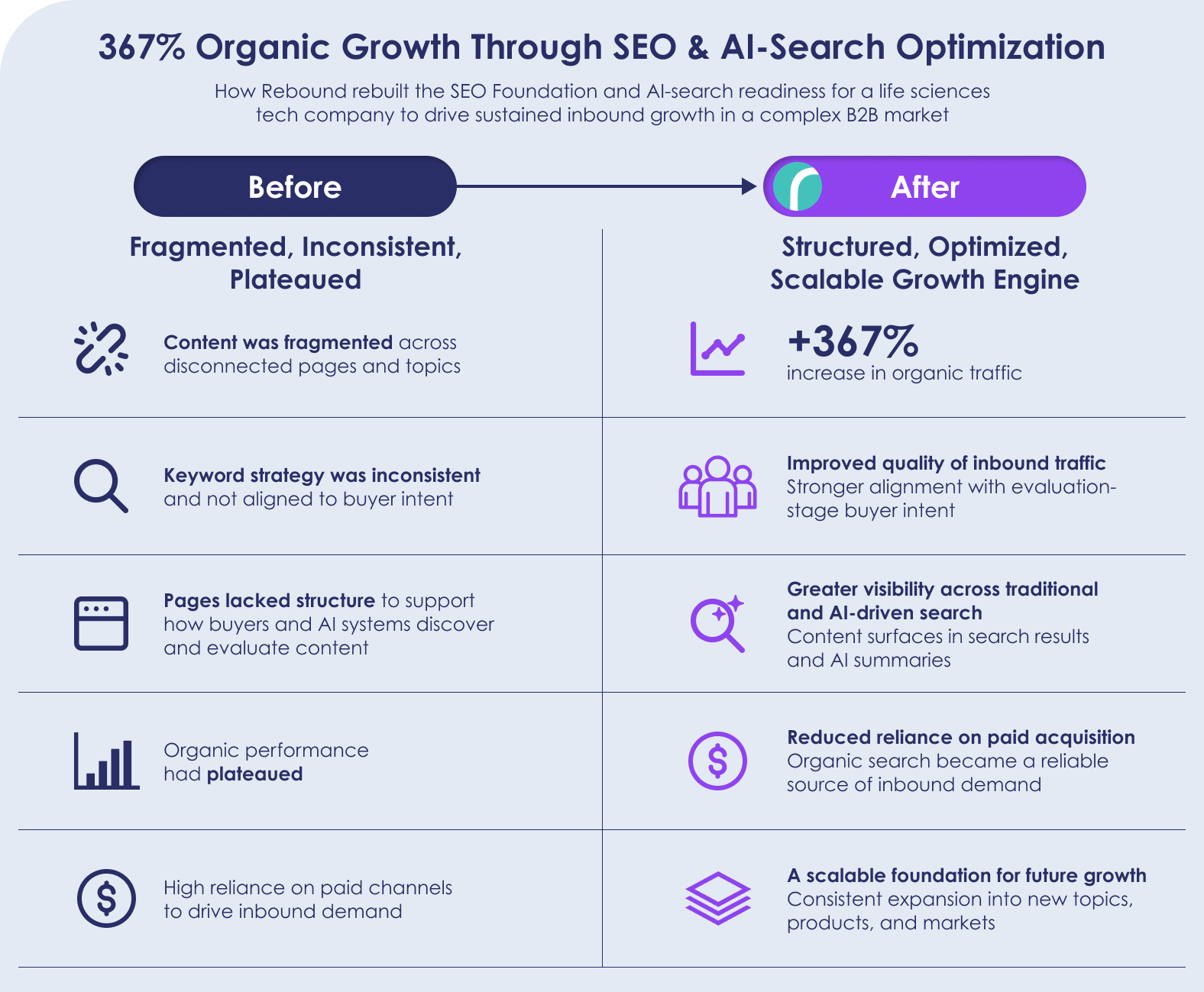
A healthcare B2B company Rebound worked with grew from 4,500 to 21,000 monthly organic users in under 12 months, not by producing more content, but by restructuring their approach around how buyers in this space actually discover and evaluate solutions, including AI-driven search.
The result is a pipeline the whole commercial team can count on and attribute to marketing for the first time.
Commercial scale depends on alignment. Marketing, sales, product, and executive leadership all need a shared understanding of who the company serves, how it wins, and how success is measured.
That alignment has practical outputs:
Organizations that build these systems make better decisions because everyone is working from the same information. In healthcare and life sciences markets specifically, where credibility and cross-functional consistency directly influence buying decisions, that coordination is a competitive advantage, not just operational hygiene. Marketing operations built around attribution and visibility is what lets marketing defend its budget with data rather than faith.
No single go-to-market strategy for healthcare SaaS companies works across every stage of growth.
The commercial model that validates a new product won’t support expansion into enterprise accounts, new verticals, or adjacent markets. Every stage of growth introduces new buyers, new competitive pressure, and greater organizational complexity. The companies that scale consistently are the ones that recognize these transitions early and build the infrastructure to support what comes next, before the current model hits its ceiling.
That’s the philosophy behind Rebound’s Marketing Acceleration™ framework, built across more than 500 engagements in health tech and B2B life sciences. Rather than treating brand, product marketing, content, demand generation, and marketing operations as separate initiatives, Marketing Acceleration™ brings them together as one coordinated system: strategy and execution moving together, giving growth-stage companies the structure to build traction quickly while creating a commercial foundation that can adapt as the business grows.
Contact Rebound to learn how Marketing Acceleration™ helps healthcare SaaS companies build a stronger commercial foundation for sustainable growth.
When should a healthcare SaaS company update its go-to-market strategy?
Update it at every major growth inflection: new markets, product launches, moving upmarket to enterprise, or declining pipeline growth. If the commercial model still depends on founder relationships or inconsistent processes, it needs revisiting now, not after the next missed quarter.
What makes a go-to-market strategy work for healthcare SaaS companies?
An effective GTM strategy aligns positioning, messaging, demand generation, sales enablement, and marketing operations around a shared commercial plan. It clearly defines the ICP, addresses multiple stakeholder types within the buying committee, and creates a repeatable process for generating and converting qualified pipeline, not just activity.
Why is go-to-market strategy different for companies selling into healthcare and life sciences?
Healthcare and life sciences organizations typically have longer buying cycles, larger buying committees, and higher expectations for technical credibility than most B2B markets. Messaging has to resonate with clinical, technical, financial, and executive stakeholders simultaneously, while demonstrating a clear understanding of regulated market dynamics. Generic B2B marketing approaches consistently underperform here.
What should be in place before scaling a commercial team?
Customer knowledge should be documented, core messaging should be defined and pressure-tested, and the GTM strategy should be clear enough that every commercial function is targeting the same customers with the same story. Hiring ahead of that foundation creates inconsistency that’s expensive to unwind.
Do healthcare SaaS companies need a full internal marketing team to scale?
Not necessarily. At the $1M to $20M ARR range, building one too early often slows things down. Many companies move faster with a fractional or embedded model that combines strategic leadership and execution capacity without the cost and ramp time of building internally. The right answer depends on stage, internal capacity, and what gaps exist in the current commercial model.
What are the signs a healthcare SaaS company has outgrown its current GTM model?
Pipeline has plateaued or become unpredictable. Sales reps are inconsistent in how they explain the product and who they target. Marketing activity isn’t traceable to revenue. New commercial hires take too long to ramp. Any one of these is a signal. All four at once means the commercial model needs to evolve before the next growth target.

To make sure you get accurate and helpful information, this guide has been edited and fact-checked by the Rebound Editorial Team.